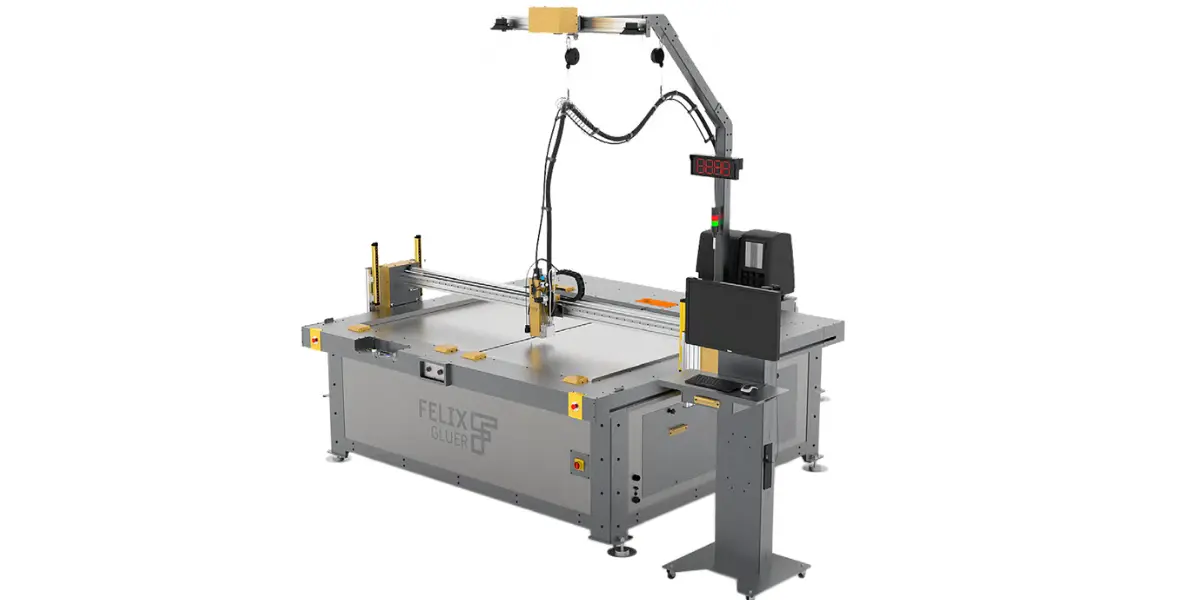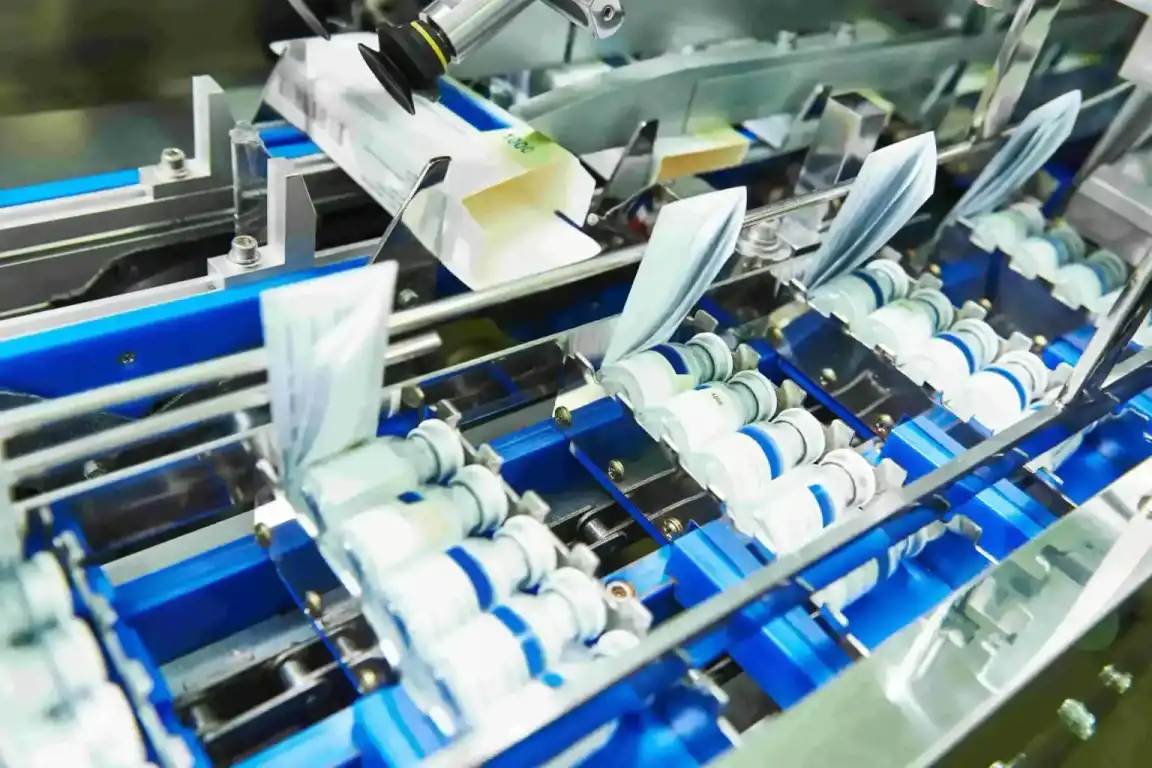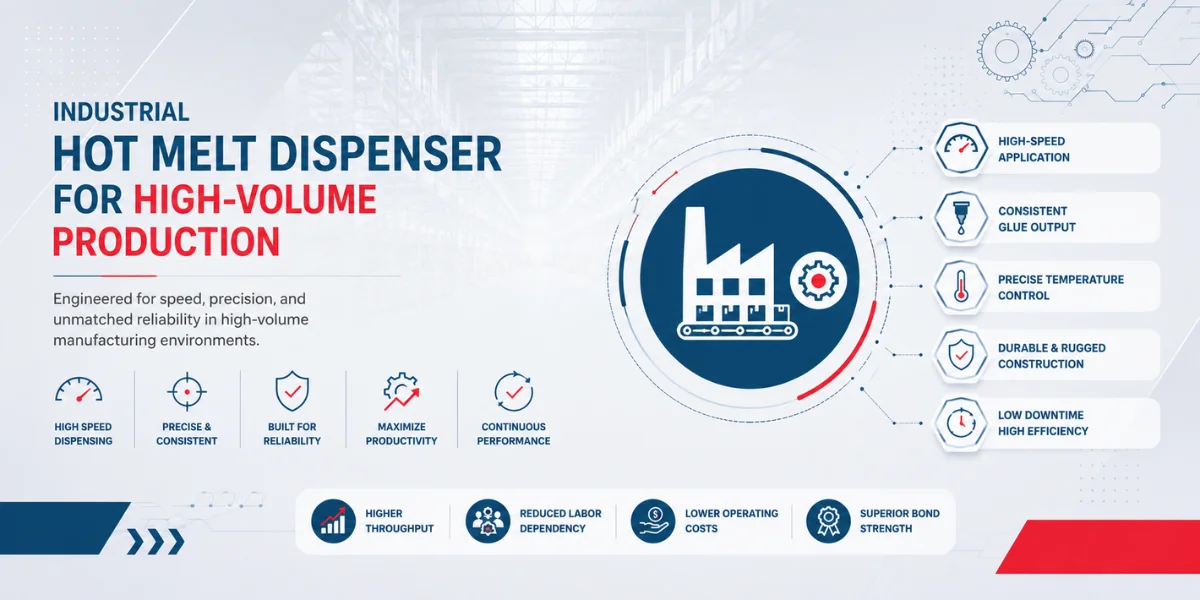
In today’s fast-paced manufacturing industry, production speed and product quality go hand in hand. Whether you’re manufacturing packaging, furniture, automotive components, electronics, hygiene products, or consumer goods, the right industrial hot melt dispenser can dramatically improve efficiency, reduce adhesive waste, and ensure consistent bonding across every production cycle.
Unlike manual adhesive application methods, modern industrial hot melt dispensers are designed for continuous, high-speed operations where precision and reliability are essential. These automated systems deliver controlled adhesive volumes while minimizing downtime and maintenance requirements.
If your production line demands thousands of adhesive applications every hour, investing in the right hot melt adhesive dispenser is no longer optional, it’s a competitive advantage.
What Is an Industrial Hot Melt Dispenser?
An industrial hot melt dispenser is an automated system that heats solid hot melt adhesives into liquid form and accurately dispenses them onto products during manufacturing.
The complete system typically consists of:
1. Hot melt tank
2. Heating system
3. Precision pumps
4. Heated hoses
5. Hot melt applicator
6. Electronic temperature controller
7. Dispensing nozzles
The adhesive remains molten throughout the system, allowing manufacturers to apply precise amounts exactly where required.
An industrial hot melt dispenser is used to heat and accurately apply hot melt adhesives in high-volume manufacturing. It is commonly used in packaging, automotive, furniture, electronics, textiles, hygiene products, and consumer goods production to ensure fast, consistent, and reliable bonding.
Industries that benefit include packaging, automotive, woodworking, furniture, electronics, medical device manufacturing, hygiene products, bookbinding, textiles, and consumer product assembly where continuous adhesive application is required.
It automates adhesive application by maintaining precise temperatures, delivering consistent adhesive volumes, reducing material waste, minimizing downtime, and increasing production speed, making it ideal for continuous manufacturing operations.
Why High-Volume Production Needs an Industrial Hot Melt Dispenser
Large-scale manufacturing requires equipment that can operate continuously without sacrificing bonding quality.
An advanced industrial glue dispenser helps manufacturers by:
1. Maintaining consistent adhesive temperature
2. Delivering uniform adhesive flow
3. Supporting multiple dispensing guns
4. Reducing operator intervention
5. Increasing production throughput
6. Eliminating adhesive overuse
7. Reducing downtime
These benefits are particularly important in industries operating 24/7 production lines.
Key Features of a High-Performance Industrial Hot Melt Dispenser
1. High Melting Capacity
High-volume production requires continuous adhesive availability.
A premium hot melt adhesive machine can melt several kilograms of adhesive per hour while maintaining constant operating temperatures.
This prevents interruptions caused by slow adhesive melting.
2. Precise Temperature Control
Different adhesives require different operating temperatures.
Modern industrial hot melt equipment offers:
1. Multi-zone temperature control
2. Digital monitoring
3. Automatic temperature recovery
4. Overheating protection
Stable temperatures improve adhesive performance while preventing degradation.
3. Accurate Adhesive Dispensing
A quality industrial adhesive dispenser delivers:
1. Dot application
2. Continuous bead dispensing
3. Spiral spray
4. Slot coating
5. Pattern application
Precise dispensing improves product quality while reducing adhesive consumption.
4. Fast Startup Time
Production efficiency depends on minimizing downtime.
Modern hot melt glue machine systems feature:
1. Rapid heating technology
2. Automatic standby mode
3. Energy-efficient heating elements
4. Fast temperature recovery
These features help manufacturers resume production quickly after maintenance or shutdowns.
5. Multi-Gun Compatibility
A single hot melt adhesive dispenser can operate multiple dispensing guns simultaneously.
This allows manufacturers to:
1. Increase production speed
2. Handle larger products
3. Apply adhesive at multiple locations simultaneously
4. Improve automation
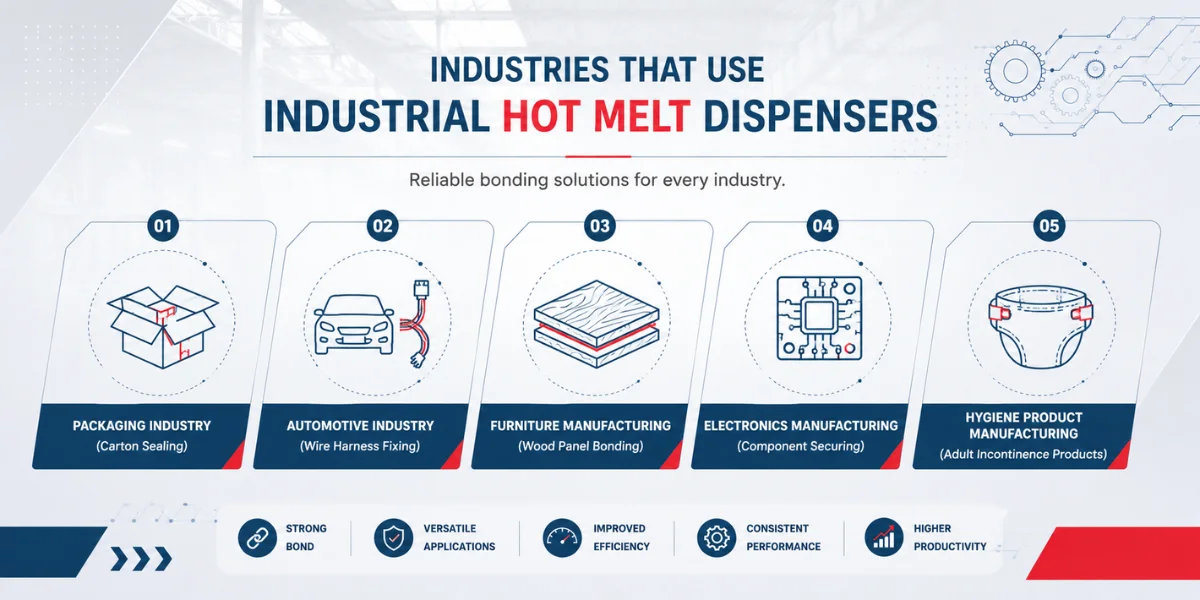
Industries That Use Industrial Hot Melt Dispensers
Industrial hot melt dispensing systems are widely used across manufacturing sectors.
Packaging Industry
Packaging manufacturers use hot melt glue dispenser machine systems for:
1. Carton sealing
2. Case erecting
3. Tray forming
4. Folding cartons
5. Food packaging
6. Beverage packaging
7. Corrugated boxes
Automotive Industry
Automotive manufacturers rely on industrial hot melt applicator systems for:
1. Interior trim assembly
2. Wire harness fixing
3. Filter assembly
4. Headliner bonding
5. Sound insulation
6. Component positioning
Furniture Manufacturing
Furniture production commonly uses:
1. Edge banding
2. Wood panel bonding
3. Mattress assembly
4. Upholstery
5. Foam bonding
Electronics Manufacturing
Applications include:
1. Component securing
2. Wire fixing
3. Protective sealing
4. Assembly operations
Hygiene Product Manufacturing
High-speed hygiene production lines use hot melt unit systems for:
1. Baby diapers
2. Adult incontinence products
3. Feminine hygiene products
4. Medical disposables
Key factors include production capacity, adhesive compatibility, melting rate, temperature control, number of dispensing guns, automation integration, maintenance requirements, energy efficiency, and future scalability.
A hot melt glue machine generally refers to the complete adhesive melting and pumping system, while a hot melt adhesive dispenser focuses on accurately applying the molten adhesive to products. In many industrial systems, both functions are integrated into a single unit.
Yes. Most modern industrial hot melt dispensers are designed for seamless integration with PLC-controlled systems, robotic arms, conveyors, vision inspection systems, and automated packaging or assembly lines, enabling high-speed, precision manufacturing.
Advantages of Industrial Hot Melt Dispensers
Higher Production Speed
Automated adhesive application allows production lines to run continuously without manual interruptions.
Lower Adhesive Consumption
Accurate dispensing minimizes waste while maintaining strong bond quality.
Improved Product Quality
Consistent adhesive patterns ensure every product receives the same bonding strength.
Reduced Operating Costs
Automation lowers labor requirements and reduces material wastage.
Better Equipment Reliability
Modern industrial hot melt equipment is designed for long operating hours with minimal maintenance.
Increased Workplace Safety
Enclosed heating systems reduce operator exposure to hot adhesives while improving overall workplace safety.
The Mahisa OneMelt Industrial Hot Melt Dispenser offers precise digital temperature control for high-volume manufacturing applications. Its advanced multi-zone heating system independently controls the adhesive tank, heated hoses, and applicators, ensuring the hot melt adhesive remains at the ideal operating temperature throughout the dispensing process.
This precise temperature management helps prevent adhesive degradation, reduces carbon build-up, improves bonding consistency, and minimizes adhesive waste. As a reliable industrial hot melt dispenser, the Mahisa OneMelt system is ideal for packaging, woodworking, automotive, electronics, and other industries that require accurate and continuous adhesive application.
The Mahisa OneMelt Industrial Hot Melt Dispenser is an excellent solution for automotive manufacturing because it delivers precise adhesive application, stable temperature control, and reliable performance on high-speed production lines. It supports applications such as interior trim bonding, wire harness assembly, filter manufacturing, insulation attachment, and component positioning.
With its advanced industrial hot melt applicator, digital controls, and compatibility with automated production systems, Mahisa’s hot melt glue dispenser machine helps automotive manufacturers improve production efficiency, reduce adhesive waste, and achieve consistent, high-strength bonding.
How an Industrial Hot Melt Dispenser Improves Manufacturing Efficiency
Manufacturers often experience several production challenges:
1. Uneven adhesive application
2. Frequent machine stoppages
3. Adhesive dripping
4. Material waste
5. Product rejection
6. Increased maintenance
An advanced industrial hot melt dispenser addresses these issues through automated adhesive control, stable temperatures, and precise dispensing technology.
The result is higher output, lower operating costs, and improved product consistency.
Choosing the Right Industrial Hot Melt Dispenser
Before selecting a dispensing system, manufacturers should evaluate:
Production Volume
Choose equipment that matches current output while allowing room for future expansion.
Adhesive Compatibility
Ensure the hot melt applicator supports the adhesive type being used, including EVA, APAO, metallocene, or PUR formulations.
Number of Dispensing Guns
Consider whether the production line requires single or multiple applicators.
Temperature Range
Select a machine with accurate and stable temperature control.
Maintenance Requirements
Easy-to-clean systems reduce downtime and increase productivity.
Automation Compatibility
The dispenser should integrate with PLCs, robotic systems, conveyors, and automated production lines.
Yes. Modern industrial hot melt dispensers are designed to integrate seamlessly with PLC-controlled systems, robotic arms, conveyors, and automated assembly lines. This allows manufacturers to achieve precise adhesive application, higher production speeds, and improved process consistency while reducing manual intervention. An automated industrial glue dispenser is ideal for packaging, automotive, woodworking, and electronics manufacturing.
Industrial hot melt dispensers are widely used in packaging, automotive, furniture, woodworking, electronics, textiles, medical device manufacturing, bookbinding, and hygiene product industries. These industries rely on hot melt adhesive machines and industrial hot melt applicators for fast, reliable, and precise adhesive application that supports continuous, high-volume production while maintaining consistent bonding performance.
Best Practices for Operating an Industrial Hot Melt Dispenser
To maximize equipment performance:
1. Use high-quality hot melt adhesives.
2. Maintain recommended operating temperatures.
3. Clean nozzles regularly.
4. Replace filters as scheduled.
5. Inspect heated hoses for wear.
6. Monitor adhesive pressure.
7. Perform preventive maintenance.
8. Train operators on proper machine handling.
Routine maintenance helps extend equipment life while maintaining consistent adhesive quality.
Regular maintenance includes cleaning dispensing nozzles, replacing filters, checking heated hoses, monitoring adhesive pressure, inspecting heating elements, and verifying temperature calibration. Preventive maintenance helps ensure reliable operation and consistent adhesive application.
Yes. Industrial-grade hot melt adhesive dispensers are specifically engineered for continuous, high-volume manufacturing. They maintain stable adhesive temperatures and consistent dispensing performance during extended production shifts, making them suitable for 24/7 industrial operations.
The performance of an industrial hot melt dispenser depends on adhesive quality, operating temperature, pump pressure, nozzle condition, production speed, maintenance practices, and correct machine settings. Optimizing these factors ensures consistent adhesive flow and reliable bonding.
Why Manufacturers Prefer Automated Hot Melt Dispensing
Manufacturers are increasingly replacing manual adhesive application with automated systems because they provide:
1. Higher production efficiency
2. Better adhesive accuracy
3. Reduced labor costs
4. Lower adhesive consumption
5. Consistent product quality
6. Improved process control
7. Faster return on investment
As manufacturing becomes more automated, industrial hot melt dispensers have become an essential part of modern production facilities.
Conclusion
A high-quality industrial hot melt dispenser is one of the most valuable investments for manufacturers operating high-volume production lines. By delivering precise adhesive application, consistent temperature control, faster production speeds, and reduced material waste, these systems help businesses improve efficiency while maintaining superior product quality.
Whether you’re upgrading an existing line or designing a new automated manufacturing facility, choosing the right industrial glue dispenser can significantly enhance productivity and reduce long-term operating costs. Investing in reliable industrial hot melt equipment ensures your production processes remain efficient, scalable, and ready to meet growing manufacturing demands.
FAQ's
A well-maintained industrial hot melt dispenser can operate reliably for 8 to 15 years or more, depending on usage, maintenance, and operating conditions. Regular cleaning, timely replacement of filters and nozzles, and preventive maintenance help extend the lifespan of the equipment while ensuring consistent adhesive performance.
Yes. Modern industrial hot melt dispensers are designed with energy-efficient heating systems, insulated tanks, and standby modes that reduce power consumption during idle periods. These features help manufacturers lower operating costs while maintaining optimal adhesive temperatures throughout production.
Most industrial hot melt dispensers are compatible with a wide range of adhesives, including EVA, APAO, metallocene, polyolefin, pressure-sensitive adhesives (PSA), and PUR hot melt adhesives. Choosing the correct adhesive depends on the substrate, bonding requirements, and production environment.
Routine inspections should be performed weekly, while preventive maintenance is typically recommended every three to six months, depending on production volume. Regular servicing helps maintain adhesive quality, reduces unexpected downtime, and extends the life of the hot melt adhesive dispenser.
Yes. Many industrial hot melt dispensers are designed to support multiple hot melt applicators simultaneously. This allows manufacturers to apply adhesive at different points on the production line, increasing throughput and improving production efficiency.
An industrial hot melt dispenser applies precise, controlled amounts of adhesive exactly where needed. Accurate dispensing minimizes over-application, reduces material waste, improves product consistency, and lowers overall adhesive consumption compared to manual application methods.
Manufacturers prefer automated industrial hot melt dispensers because they improve production speed, ensure precise adhesive application, reduce labor costs, minimize adhesive waste, and deliver consistent product quality. Automation also supports higher throughput and better process control in modern manufacturing environments.