Choosing the right hot melt glue machine is an important investment for manufacturers that depend on fast, consistent, and reliable adhesive application. A machine may look impressive on paper, but its actual quality depends on much more than price, appearance, or advertised specifications.
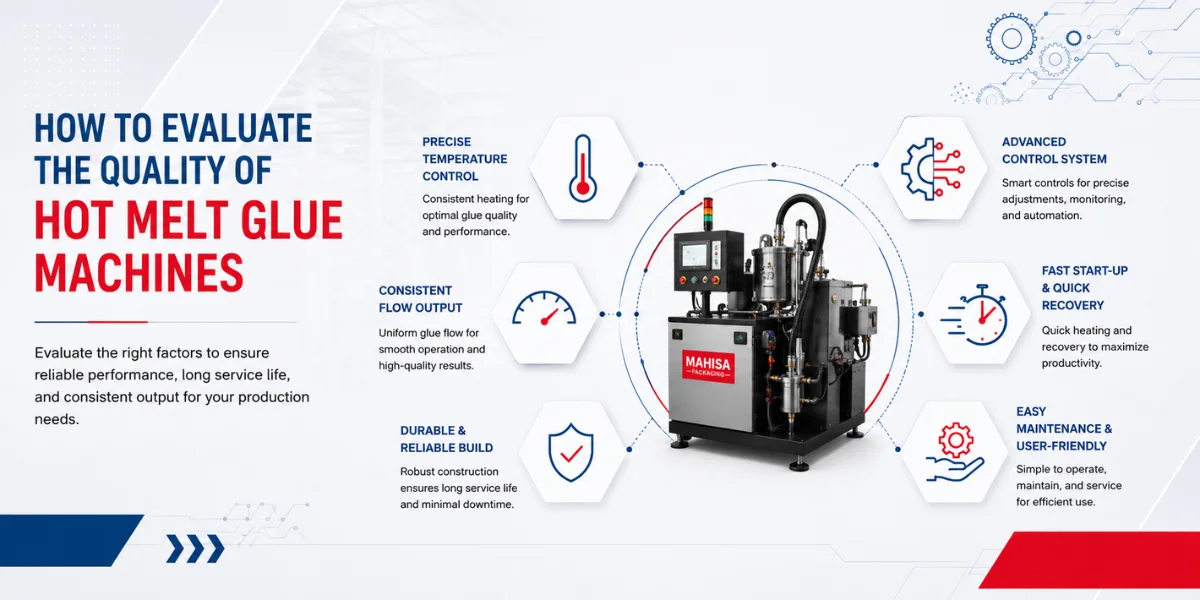
Evaluate Quality Hot Melt Glue Machines by looking beyond price, appearance, or advertised specifications. Choosing the right hot melt glue machine is an important investment for manufacturers that need fast, consistent, and reliable adhesive application. Machine quality depends on factors such as temperature control, dispensing accuracy, build quality, safety, efficiency, and long-term performance.
A high-quality hot melt glue machine should provide accurate temperature control, consistent adhesive flow, dependable construction, safe operation, energy efficiency, and reliable performance over extended production cycles.
But how do you evaluate the quality of a hot melt glue machine before buying it?
The best approach is to assess the machine across several areas, including construction, heating technology, adhesive compatibility, dispensing accuracy, automation, safety, maintenance, and manufacturer support.
This guide explains the most important factors to check so businesses can make a confident and informed purchasing decision.
FAQs: How to Evaluate the Quality of Hot Melt Glue Machines
1. What should I check first when evaluating a hot melt glue machine?
Start by checking the machine’s build quality, temperature control, adhesive compatibility, dispensing accuracy, pump performance, safety features, and suitability for your production requirements.
2. How can I test the dispensing accuracy of a hot melt glue machine?
Run the machine with your intended adhesive and measure the consistency of adhesive output across multiple cycles. Uniform flow, accurate application patterns, and reliable cut-off indicate good dispensing performance.
3. Why is temperature control important when evaluating a hot melt glue machine?
Accurate temperature control helps maintain the adhesive at its recommended processing temperature, supporting consistent viscosity, stable flow, and reliable bonding quality.
4. What role does machine testing play in evaluating hot melt glue machine quality?
Machine testing allows buyers to assess heating time, temperature stability, adhesive flow, applicator response, pressure consistency, and overall performance before committing to a purchase.
5. How can I compare the quality of two hot melt glue machines?
Compare their construction, heating technology, temperature accuracy, dispensing performance, energy efficiency, safety features, maintenance requirements, warranty, spare-parts availability, and total cost of ownership rather than comparing price alone.
What Makes a High-Quality Hot Melt Glue Machine?
A quality hot melt glue machine should consistently melt and dispense adhesive according to the requirements of the application.
Key indicators of quality include:
- Stable temperature control
- Consistent adhesive output
- Durable machine construction
- Reliable pumping performance
- Efficient heating
- Accurate dispensing
- Safe operation
- Easy maintenance
- Compatible components
- Strong technical support
The machine should also be capable of maintaining performance during the operating conditions for which it was designed.
1. Check the Machine’s Build Quality
The physical construction of a hot melt glue machine provides important clues about its durability.
Examine:
- Adhesive tank construction
- Heating system
- Pump assembly
- Electrical components
- Hoses
- Applicators
- Control panel
- Insulation
- Fittings and connections
Industrial machines designed for continuous production should use durable components suitable for their intended operating environment.
A strong build reduces the likelihood of premature wear and unexpected breakdowns.
2. Evaluate Temperature Control Accuracy
Temperature control is one of the most important quality indicators in a hot melt adhesive machine.
Hot melt adhesives must be heated within their recommended processing range. Excessive temperatures can affect adhesive properties, while insufficient temperatures can result in poor melting and inconsistent dispensing.
Look for:
- Digital temperature displays
- Accurate temperature sensors
- Multiple heating zones
- Independent temperature control
- Automatic temperature regulation
- Over-temperature protection
Stable temperature control helps produce consistent adhesive performance from one production cycle to another.
3. Examine Adhesive Melting Performance
A quality machine should melt adhesive efficiently and consistently.
Evaluate whether the machine can:
- Reach the required operating temperature efficiently
- Maintain a stable adhesive temperature
- Prevent excessive adhesive degradation
- Handle the required adhesive volume
- Recover temperature quickly after adhesive replenishment
For high-volume manufacturing, consistent melting performance is essential because production interruptions can affect output and delivery schedules.
4. Check Adhesive Compatibility
Not every hot melt machine is suitable for every adhesive.
Depending on the application, machines may be designed to process:
- EVA hot melt adhesives
- Polyolefin adhesives
- Pressure-sensitive adhesives
- PUR hot melt adhesives
- Specialty hot melt formulations
Before buying, provide the manufacturer with the adhesive’s technical specifications.
Important factors include:
- Melting temperature
- Viscosity
- Application temperature
- Required pressure
- Open time
- Adhesive format
A quality manufacturer should be able to confirm machine compatibility before installation.
5. Evaluate Adhesive Dispensing Accuracy
Consistent dispensing is essential for maintaining product quality and controlling adhesive consumption.
Check whether the machine provides:
- Stable adhesive flow
- Consistent pressure
- Accurate dispensing volume
- Controlled application patterns
- Reliable nozzle performance
Poor dispensing accuracy can result in excessive adhesive use, weak bonds, messy application, and product rejection.
For high-volume production, even small variations in adhesive output can create significant material waste.
6. Assess Pump Performance
The pump is a critical component because it controls how adhesive moves from the tank to the applicator.
When evaluating pump quality, consider:
- Flow consistency
- Pressure stability
- Pump capacity
- Response time
- Durability
- Maintenance requirements
The pump should be appropriately matched to the adhesive viscosity and production requirements.
7. Test Heating Efficiency
Heating performance affects both productivity and operating costs.
A good machine should heat the adhesive efficiently without unnecessary energy consumption.
Look for:
- Proper tank insulation
- Efficient heating elements
- Controlled heating zones
- Reduced heat loss
- Automatic standby functions
Energy-efficient heating can help lower electricity consumption while maintaining consistent adhesive temperatures.
8. Inspect the Applicator and Nozzle Quality
The applicator is the final point where adhesive reaches the product, making its quality extremely important.
Evaluate:
- Nozzle design
- Application accuracy
- Response time
- Adhesive cut-off
- Drip prevention
- Ease of cleaning
A poor-quality nozzle can cause adhesive stringing, dripping, uneven application, or inconsistent bonding.
The applicator should be appropriate for the required application pattern and production speed.
9. Review Hose Quality
Heated hoses transport adhesive between the machine and applicator.
A quality hose should provide:
- Consistent heating
- Good insulation
- Adequate flexibility
- Reliable electrical connections
- Durable construction
- Secure fittings
Poor-quality hoses can create heat loss, adhesive blockages, leaks, or inconsistent application temperatures.
10. Evaluate Control and Automation Features
Modern hot melt glue machines may include advanced controls that improve consistency and ease of operation.
Depending on your application, useful features can include:
- Digital controls
- Touchscreen interfaces
- PLC integration
- Programmable temperature settings
- Pressure monitoring
- Automatic adhesive output control
- Standby modes
- Production-line synchronization
Automation should match the complexity of your production process. A simple application may not require an advanced control system, while high-speed manufacturing may benefit significantly from automation.
11. Check Safety Features
Hot melt glue machines operate at elevated temperatures and may use pressurised adhesive.
Safety features should therefore be a major part of the quality evaluation.
Look for:
- Over-temperature protection
- Emergency stop functions
- Pressure relief systems
- Insulated surfaces
- Electrical protection
- Warning indicators
- Safe maintenance access
Ask the manufacturer for relevant safety and compliance documentation for the market where the equipment will be installed.
12. Evaluate Ease of Maintenance
A high-quality machine should not only perform well; it should also be practical to maintain.
Check whether operators can easily access:
- Filters
- Pumps
- Heating components
- Sensors
- Hoses
- Applicators
- Nozzles
Clear maintenance instructions and accessible components can reduce servicing time and help prevent unnecessary downtime.
13. Check Spare Parts Availability
Before purchasing, ask the manufacturer which components are normally replaced during the machine’s service life.
Important spare parts may include:
- Filters
- Heating elements
- Temperature sensors
- Pumps
- Hoses
- Nozzles
- Seals
- Applicator components
A manufacturer with dependable spare-parts support can help keep the machine operational for longer.
14. Request a Machine Demonstration
One of the best ways to evaluate a hot melt glue machine is to see it operating.
During a demonstration, observe:
- Heating time
- Temperature stability
- Adhesive flow
- Dispensing accuracy
- Applicator response
- Control-panel usability
- Noise and vibration
- Overall machine operation
If possible, test the machine using the actual adhesive and materials used in your production process.
This provides a much more realistic assessment than relying only on brochures or specifications.
15. Review Factory Testing and Quality Control
Ask the manufacturer how each machine is tested before delivery.
Quality-control procedures may include:
- Electrical testing
- Temperature testing
- Pressure testing
- Pump testing
- Adhesive dispensing tests
- Safety-function checks
Manufacturers with structured quality-control processes are more likely to deliver consistent equipment.
16. Evaluate Manufacturer Experience
Machine quality is closely connected to the manufacturer’s technical expertise.
Consider:
- Years of manufacturing experience
- Industry applications served
- Engineering capabilities
- Customization options
- Installation support
- Technical documentation
- Customer references
An experienced manufacturer can help select the appropriate machine rather than simply selling a standard model.
17. Consider the Total Cost of Ownership
The cheapest machine is not always the most economical choice.
Evaluate:
Total Cost of Ownership = Purchase Price + Energy + Adhesive + Maintenance + Spare Parts + Downtime
A quality machine may have a higher initial purchase price but deliver savings through:
- Lower adhesive waste
- Reduced energy consumption
- Fewer breakdowns
- Lower maintenance costs
- Longer service life
- Higher production efficiency
This is why buyers should compare long-term operating costs instead of focusing only on the initial quotation.
18. Check Warranty and After-Sales Support
A manufacturer’s warranty provides an additional indication of its confidence in the equipment.
Ask about:
- Warranty duration
- Covered components
- Service response time
- Technical support
- Installation assistance
- Operator training
- Spare-parts availability
Strong after-sales support is especially important for businesses running continuous production.
FAQs: What Makes a High-Quality Hot Melt Glue Machine?
1. How can I identify a high-quality hot melt glue machine?
A high-quality hot melt glue machine typically offers stable temperature control, consistent adhesive flow, durable components, accurate dispensing, reliable heating, safety features, and easy maintenance.
2. Why is consistent adhesive flow important in a hot melt glue machine?
Consistent adhesive flow ensures uniform bonding across products, reduces adhesive waste, and helps maintain consistent production quality during continuous operation.
3. Does machine construction affect the lifespan of a hot melt glue machine?
Yes. Durable tanks, pumps, heating components, hoses, and electrical systems can withstand demanding production conditions and contribute to longer equipment service life.
4. What role does temperature stability play in machine quality?
Temperature stability helps maintain the adhesive within its recommended processing range, supporting consistent viscosity, reliable dispensing, and dependable bonding performance.
5. Can a high-quality hot melt glue machine reduce production costs?
Yes. Efficient heating, precise dispensing, reduced adhesive waste, fewer breakdowns, and lower maintenance requirements can help reduce overall operating costs.
Quality Evaluation Checklist for Hot Melt Glue Machines
Before making a purchase, use this quick checklist:
| Quality Factor | What to Evaluate |
|---|---|
| Construction | Durable materials and components |
| Temperature | Accuracy and stability |
| Heating | Speed and energy efficiency |
| Pump | Flow and pressure consistency |
| Dispensing | Accuracy and repeatability |
| Applicator | Nozzle performance and response |
| Hose | Heating, insulation and flexibility |
| Safety | Protection and emergency systems |
| Controls | Ease of use and automation |
| Maintenance | Accessibility and service requirements |
| Spare parts | Availability and support |
| Testing | Factory quality-control procedures |
| Warranty | Coverage and service terms |
| Manufacturer | Experience and technical expertise |
Common Mistakes to Avoid When Evaluating Machine Quality
Buyers should avoid making decisions based solely on:
Lowest Price
A low purchase price does not necessarily mean lower total cost.
Appearance
A well-finished machine may look impressive, but internal components and performance are more important.
Maximum Capacity
A machine with extremely high output may not be suitable for your specific application.
Marketing Claims
Always verify performance specifications through documentation, demonstrations, or testing.
Brand Name Alone
A recognised brand does not automatically guarantee that a particular machine configuration is suitable for your process.
FAQs: Common Mistakes to Avoid When Evaluating Machine Quality
1. Is choosing the lowest-priced hot melt glue machine a common purchasing mistake?
Yes. Focusing only on the initial price can lead to higher long-term expenses if the machine has poor energy efficiency, excessive adhesive consumption, frequent maintenance needs, or limited service support.
2. Why should buyers avoid judging machine quality by appearance alone?
A machine’s external finish does not necessarily indicate its internal quality or performance. Buyers should also evaluate components, temperature control, dispensing accuracy, safety systems, and operating reliability.
3. Can relying only on manufacturer marketing claims lead to a poor machine selection?
Yes. Buyers should verify performance claims through technical specifications, certifications, machine demonstrations, testing, and customer references before making a purchase decision.
4. Why is choosing a machine based only on maximum capacity a mistake?
The highest output machine may not match your actual adhesive requirements or production process. Selecting equipment based on your required flow rate, operating hours, adhesive type, and application can provide better efficiency.
5. Should buyers evaluate after-sales support when comparing machine quality?
Yes. Warranty coverage, spare-parts availability, technical assistance, installation support, and maintenance services are important indicators of the machine’s long-term value and reliability.
Conclusion
Evaluating the quality of hot melt glue machines requires a comprehensive approach. Buyers should look beyond price and examine the machine’s construction, heating system, temperature control, adhesive compatibility, pump performance, dispensing accuracy, applicator quality, safety features, automation, maintenance, and after-sales support.
A machine that performs consistently, uses energy efficiently, minimises adhesive waste, and remains reliable under demanding production conditions can provide significantly greater long-term value.
Before making a final decision, request technical documentation, compare specifications, inspect critical components, ask about quality-control procedures, and, whenever possible, conduct a machine demonstration using your actual adhesive and production materials.
The best hot melt glue machine is not simply the machine with the most features, it is the machine that delivers consistent performance, safe operation, efficient adhesive use, and reliable results for your specific manufacturing process.
Frequently Asked Questions
How can I check the quality of a hot melt glue machine before purchasing?
Evaluate its construction, temperature control, adhesive compatibility, dispensing accuracy, pump performance, heating efficiency, safety features, maintenance requirements, spare-parts availability, and manufacturer support. A live machine demonstration can provide additional confidence.
What is the most important quality feature in a hot melt glue machine?
Temperature stability is one of the most important features because adhesive performance depends heavily on maintaining the correct processing temperature. However, overall machine quality also depends on dispensing accuracy, pump performance, safety, and reliability.
How do I know if a hot melt machine is suitable for my adhesive?
Check the adhesive’s technical data sheet for melting temperature, viscosity, and recommended application conditions. Provide this information to the machine manufacturer so they can confirm equipment compatibility.
Does a more expensive hot melt glue machine always have better quality?
Not necessarily. Price should be evaluated alongside machine specifications, component quality, performance, service support, and total cost of ownership. The best machine is one that meets your application requirements reliably.
Why is a machine demonstration important before buying?
A demonstration allows buyers to observe heating performance, temperature stability, adhesive flow, dispensing accuracy, controls, and applicator response under actual operating conditions.
How important is after-sales service for hot melt glue machines?
After-sales service is highly important because technical support, spare parts, maintenance guidance, and troubleshooting can reduce downtime and help maintain machine performance throughout its service life.