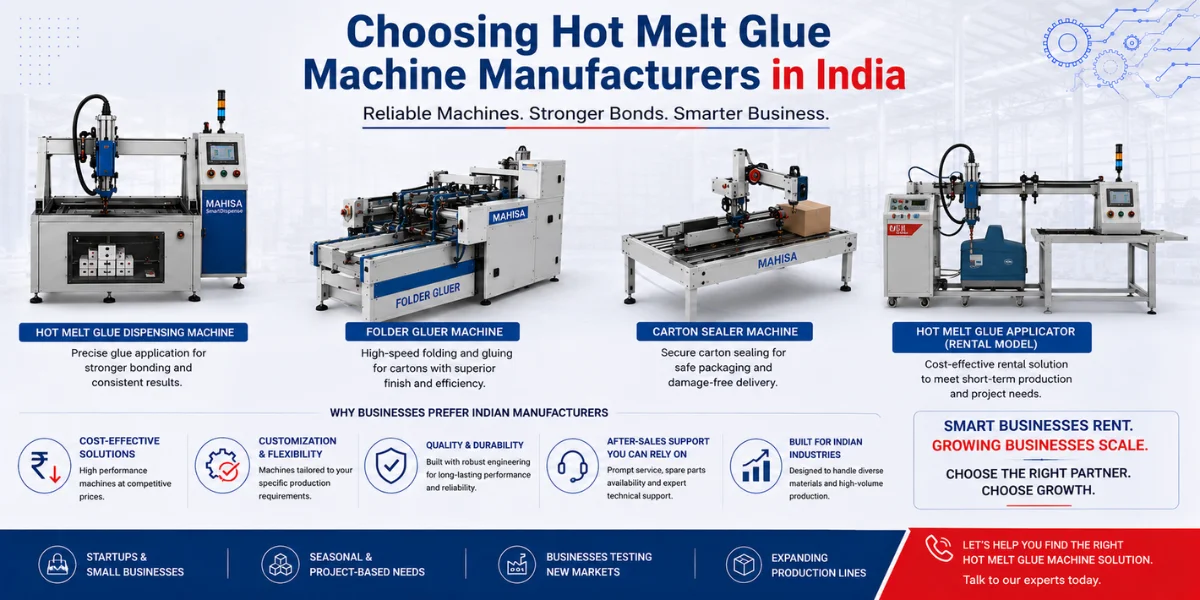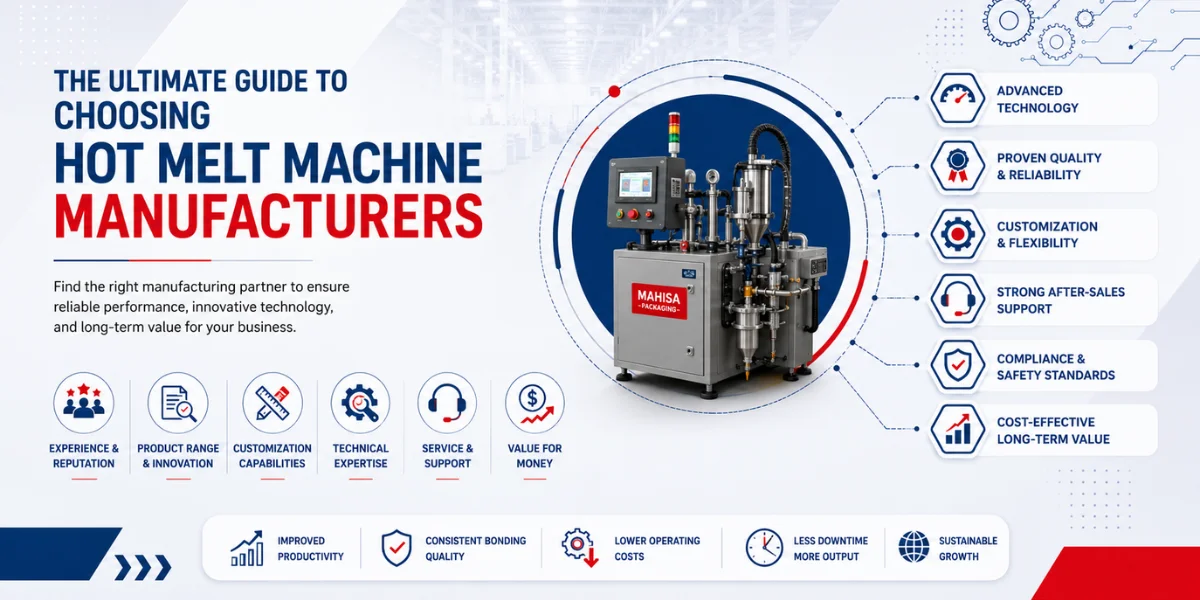
Choosing the right hot melt machine manufacturer is an important decision for businesses that depend on fast, accurate, and reliable adhesive application. A hot melt machine is not simply a piece of production equipment; it can directly influence bonding quality, production speed, adhesive consumption, maintenance costs, and overall manufacturing efficiency.
With many hot melt machine manufacturers offering different technologies, capacities, features, and price points, comparing suppliers can be challenging. The lowest-priced machine may not always provide the best long-term value, while the most advanced system may be unnecessary for a smaller production operation.
So, how do you choose the right hot melt machine manufacturer?
The answer is to evaluate the manufacturer based on machine quality, technical expertise, customization capabilities, safety, after-sales support, energy efficiency, and total cost of ownership.
This guide explains the key factors to consider before selecting a hot melt machine manufacturer for your business.
What Is a Hot Melt Machine Manufacturer?
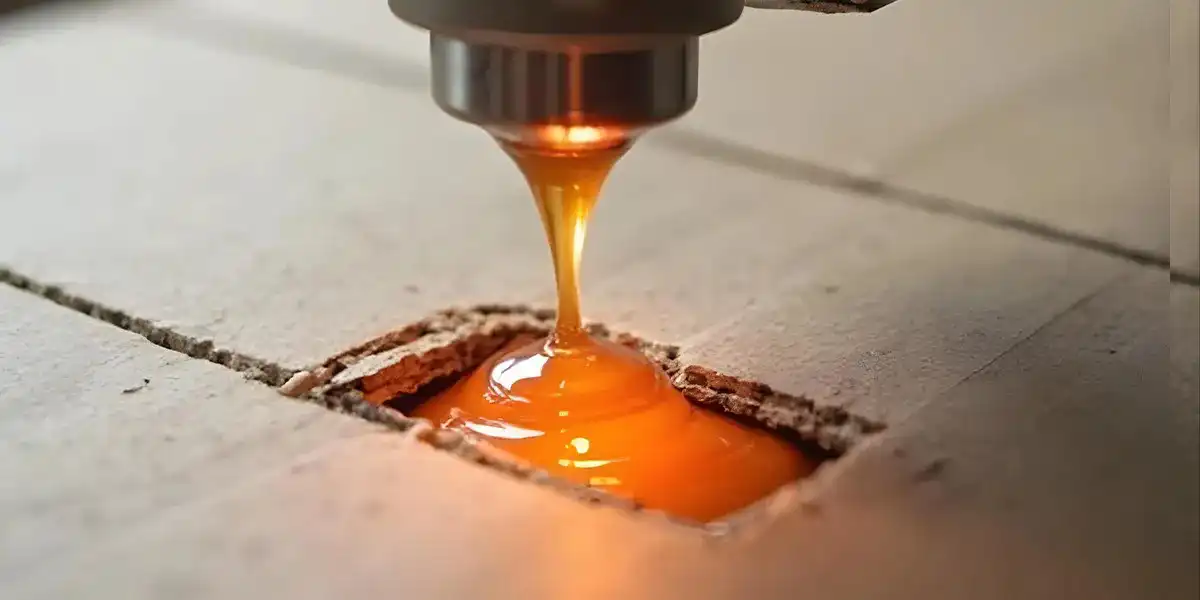
A hot melt machine manufacturer designs, develops, produces, and supplies equipment used to melt and dispense thermoplastic adhesive materials.
Depending on the application, these machines can include:
- Hot melt adhesive tanks
- Heating systems
- Pumps
- Heated hoses
- Glue guns and applicators
- Nozzles
- Temperature controllers
- Pressure control systems
- Digital control panels
- Automatic dispensing systems
Manufacturers may supply standalone machines or complete adhesive application systems that integrate with packaging and automated production lines.
A reliable manufacturer should understand not only how to build the machine but also how the equipment will perform in the customer’s actual production environment.
FAQs: What Is a Hot Melt Machine Manufacturer?
1. What does a hot melt machine manufacturer do?
A hot melt machine manufacturer designs and produces equipment that melts, controls, and dispenses hot melt adhesives for industrial applications. Manufacturers may also provide installation, customization, maintenance, and technical support.
2. What types of equipment do hot melt machine manufacturers produce?
Hot melt machine manufacturers typically produce adhesive melting units, heated hoses, glue applicators, pumps, nozzles, temperature controllers, and complete automatic or manual dispensing systems.
3. How does a hot melt machine manufacturer support industrial applications?
Manufacturers can recommend machine configurations based on production speed, adhesive type, application method, dispensing volume, and integration requirements, helping businesses select suitable equipment.
4. Can hot melt machine manufacturers design customized adhesive systems?
Yes. Many manufacturers can customize tank capacity, number of adhesive outlets, hose lengths, applicator configurations, pumps, controls, and other components according to specific production requirements.
5. Why should businesses choose an experienced hot melt machine manufacturer?
An experienced manufacturer can provide better application guidance, reliable machine construction, appropriate adhesive compatibility, technical support, spare parts, and long-term maintenance assistance.
Why Choosing the Right Manufacturer Matters
The manufacturer you select can influence the entire lifecycle of your adhesive system.
A reputable manufacturer can provide:
- Consistent machine performance
- Reliable adhesive application
- Better production efficiency
- Reduced adhesive waste
- Technical assistance
- Spare parts availability
- Operator training
- Preventive maintenance support
- Machine customization
- Long-term serviceability
Choosing an experienced supplier also reduces the risk of purchasing equipment that does not match your adhesive, production speed, or application requirements.
1. Evaluate the Manufacturer’s Industry Experience
One of the first things to investigate is how long the manufacturer has been designing and producing hot melt equipment.
Experience matters because different industries have different adhesive requirements.
For example, packaging applications may require high-speed carton sealing, while furniture manufacturing may require precise adhesive application across different materials.
Ask manufacturers:
- How many years have you manufactured hot melt equipment?
- Which industries do you serve?
- What types of adhesives do your machines support?
- Can you provide application-specific recommendations?
- Do you have experience with automated production lines?
A manufacturer with relevant industry experience is more likely to recommend an appropriate machine configuration.
2. Check Machine Quality and Construction
Machine construction has a direct effect on reliability and service life.
Look for equipment manufactured using durable components and appropriate materials.
Important areas to evaluate include:
- Adhesive tank construction
- Heating elements
- Pumps
- Electrical components
- Hoses
- Applicators
- Temperature sensors
- Control systems
- Insulation
A quality hot melt machine should be designed for the intended production environment and operating hours.
For continuous industrial applications, heavy-duty construction is particularly important.
3. Examine Temperature Control Technology
Temperature control is one of the most important features of a hot melt adhesive machine.
The machine must maintain the adhesive within the recommended temperature range throughout the process.
Advanced systems may provide:
- Digital temperature displays
- Multiple heating zones
- Independent temperature control
- Automatic temperature regulation
- Over-temperature protection
- Temperature alarms
Accurate temperature management helps maintain adhesive consistency while reducing overheating, adhesive degradation, and unnecessary energy consumption.
4. Consider Production Capacity
The right machine should match your production volume.
Before contacting a manufacturer, determine:
- Required adhesive output
- Production speed
- Operating hours per day
- Number of dispensing points
- Tank capacity
- Required pressure
- Application frequency
A machine that is too small may struggle to keep up with production. A machine that is significantly oversized may increase the initial investment and operating costs unnecessarily.
A good manufacturer should help calculate the appropriate capacity based on your production requirements.
5. Look for Customization Options
Different manufacturing applications often require different machine configurations.
A capable manufacturer should be able to customize elements such as:
- Tank capacity
- Number of glue outlets
- Hose length
- Applicator type
- Nozzle configuration
- Pump capacity
- Control systems
- Mounting arrangements
- Automation interfaces
Customization is particularly valuable when integrating hot melt equipment into an existing production line.
6. Verify Adhesive Compatibility
Before purchasing a machine, confirm that the manufacturer supports the adhesive you intend to use.
Depending on the application, hot melt systems may be designed for adhesives such as:
- EVA hot melt
- Polyolefin hot melt
- Pressure-sensitive hot melt
- PUR hot melt
- Specialty industrial adhesives
The adhesive’s melting temperature, viscosity, application method, and curing characteristics can influence machine selection.
A knowledgeable manufacturer should be able to recommend equipment based on the adhesive’s technical requirements.
7. Assess Automation and Control Features
Automation can significantly improve production consistency.
Modern industrial hot melt machines may include:
- PLC-based controls
- Touchscreen interfaces
- Automatic temperature regulation
- Programmable adhesive output
- Pressure monitoring
- Production-line synchronization
- Automatic standby modes
- Remote monitoring capabilities
For high-volume production, automation can reduce manual intervention and improve repeatability.
However, automation should be selected according to actual production requirements rather than added simply because it is available.
8. Prioritize Safety Features
Hot melt equipment operates at elevated temperatures, making safety an essential consideration.
Ask manufacturers about features such as:
- Over-temperature protection
- Emergency stop systems
- Pressure relief mechanisms
- Insulated surfaces
- Electrical protection
- Guarded components
- Safe maintenance access
- Warning indicators
Also check whether the machine complies with applicable safety and electrical requirements for the market where it will be installed.
A manufacturer that prioritizes safety demonstrates a commitment to responsible industrial equipment design.
9. Check Energy Efficiency
Heating adhesive continuously can consume significant energy, particularly in high-volume manufacturing.
Look for machines designed with:
- Efficient heating elements
- Proper tank insulation
- Controlled heating zones
- Automatic standby functions
- Reduced heat loss
- Intelligent temperature management
Energy-efficient equipment can help reduce operating expenses while maintaining the required adhesive temperature.
10. Evaluate After-Sales Service
A machine purchase should not end when the equipment is delivered.
After-sales support can be critical when the machine is operating continuously.
Ask whether the manufacturer provides:
- Installation assistance
- Machine commissioning
- Operator training
- Troubleshooting support
- Preventive maintenance guidance
- Spare parts
- Repair services
- Technical documentation
A manufacturer with strong after-sales support can help minimise downtime and extend equipment life.
11. Check Spare Parts Availability
Even a well-built machine eventually requires replacement components.
Before purchasing, determine whether essential parts are readily available.
These may include:
- Heating elements
- Temperature sensors
- Filters
- Pumps
- Hoses
- Nozzles
- Seals
- Applicator components
Easy access to genuine replacement parts can reduce repair times and prevent prolonged production interruptions.
12. Compare Total Cost of Ownership
Machine price should not be the only purchasing consideration.
The total cost of ownership includes:
Purchase price + installation + energy consumption + adhesive usage + maintenance + spare parts + downtime costs
A machine with a lower initial price may become more expensive if it consumes more energy, wastes adhesive, requires frequent repairs, or lacks technical support.
A slightly higher-quality machine can deliver better long-term value through improved efficiency and reliability.
13. Review Manufacturer Reputation
Before making a final decision, research the manufacturer’s reputation.
Consider:
- Customer reviews
- Industry experience
- Product portfolio
- Customer references
- Technical capabilities
- Export experience
- Warranty policies
- Service infrastructure
You can also ask the manufacturer for examples of similar installations or applications they have supported.
Real-world experience can provide valuable insight into machine reliability and customer service.
14. Ask About Testing and Quality Control
A professional manufacturer should have quality-control procedures throughout the production process.
Ask how machines are tested before dispatch.
Testing may include:
- Temperature testing
- Pressure testing
- Electrical testing
- Pump performance testing
- Adhesive dispensing tests
- Safety-function testing
Factory testing helps identify potential problems before the equipment reaches the production floor.
15. Consider Future Production Expansion
Your current production requirements may not remain the same.
If you expect production to grow, consider whether the machine can support future requirements.
Ask about:
- Additional adhesive outlets
- Higher production rates
- Additional applicators
- Automation upgrades
- Larger tanks
- Production-line integration
Selecting scalable equipment can reduce the need for a complete replacement when production increases.
FAQs: Why Choosing the Right Manufacturer Matters
1. How does the right hot melt machine manufacturer affect production quality?
The right manufacturer provides equipment with precise temperature control, consistent adhesive flow, and reliable dispensing, helping maintain uniform bonding quality throughout production.
2. Can the right manufacturer help reduce adhesive consumption?
Yes. A properly designed hot melt system can provide accurate adhesive dispensing, helping minimise over-application, material waste, and unnecessary adhesive costs.
3. Why is technical expertise important when selecting a hot melt machine manufacturer?
Technical expertise allows the manufacturer to recommend suitable machine capacity, adhesive compatibility, applicators, and operating parameters based on the customer’s specific production requirements.
4. How does manufacturer support affect hot melt machine downtime?
Reliable technical support, troubleshooting, maintenance guidance, and spare-parts availability can help resolve machine issues faster and reduce costly production interruptions.
5. Can choosing the right manufacturer improve the long-term value of a hot melt machine?
Yes. A reliable manufacturer can provide durable equipment, proper installation, maintenance support, upgrades, and replacement parts, helping extend machine life and improve the overall return on investment.
How to Compare Hot Melt Machine Manufacturers
A simple evaluation checklist can make supplier comparison easier.
| Evaluation Factor | What to Check |
|---|---|
| Experience | Years of hot melt equipment manufacturing |
| Machine quality | Components, construction, durability |
| Capacity | Adhesive output and production requirements |
| Compatibility | Supported adhesive types |
| Automation | PLC, touchscreen, line integration |
| Safety | Temperature, pressure, and electrical protection |
| Customization | Machine configuration options |
| Energy efficiency | Heating and insulation technology |
| Service | Installation and technical support |
| Spare parts | Availability and delivery time |
| Warranty | Coverage and terms |
| Cost | Total cost of ownership |
This approach allows manufacturers to compare suppliers based on overall value instead of price alone.
Red Flags to Avoid When Choosing a Manufacturer
Be cautious if a supplier:
- Cannot clearly explain machine specifications
- Provides limited technical documentation
- Does not offer adequate after-sales support
- Has unclear warranty terms
- Cannot confirm adhesive compatibility
- Has poor spare-parts availability
- Avoids discussing safety features
- Cannot provide application guidance
- Focuses only on low purchase price
A reliable manufacturer should be transparent about machine capabilities, limitations, maintenance, and operating requirements.
Why Indian Hot Melt Machine Manufacturers Are Worth Considering
India has become an important manufacturing hub for industrial machinery and adhesive application equipment.
Working with an Indian hot melt machine manufacturer can offer advantages such as:
- Competitive manufacturing costs
- Custom machine configurations
- Local technical support
- Easier spare-parts availability
- Faster communication
- Application-specific engineering
- Export-oriented manufacturing capabilities
For Indian manufacturers, working with a local supplier can also simplify installation, service, training, and maintenance.
However, buyers should still evaluate each manufacturer based on quality, technical expertise, safety, service, and proven performance rather than geographic location alone.
FAQs: Why Indian Hot Melt Machine Manufacturers Are Worth Considering
1. What advantages do Indian hot melt machine manufacturers offer to industrial buyers?
Indian hot melt machine manufacturers can offer competitive pricing, customized equipment, application-specific solutions, and accessible technical support while maintaining the requirements of industrial production.
2. Can Indian hot melt machine manufacturers supply machines for international markets?
Yes. Many Indian manufacturers produce industrial hot melt equipment for domestic and international customers and can support different production requirements and export markets.
3. Are Indian hot melt machines suitable for high-volume manufacturing?
Yes. Indian manufacturers offer hot melt systems with different capacities, dispensing configurations, and automation levels that can be designed for continuous and high-volume production.
4. Can businesses get customized hot melt machines from manufacturers in India?
Yes. Indian manufacturers can provide customized solutions based on adhesive type, tank capacity, number of applicators, dispensing speed, production-line integration, and other application requirements.
5. How important is local technical support when buying from an Indian manufacturer?
Local technical support can make installation, troubleshooting, preventive maintenance, and spare-parts procurement easier and faster, helping businesses minimise equipment downtime.
Questions to Ask Before Selecting a Hot Melt Machine Manufacturer
Before placing an order, ask these essential questions:
- What type of hot melt machine is suitable for my application?
- Which adhesives can the machine process?
- What is the machine’s maximum adhesive output?
- Can the system be customized?
- Can it integrate with my existing production line?
- What safety features are included?
- What certifications and compliance documentation are available?
- What warranty is provided?
- How quickly are spare parts available?
- What technical support is available after installation?
The answers will help you determine whether the manufacturer can support your requirements both now and in the future.
Conclusion
Choosing among hot melt machine manufacturers requires more than comparing machine prices. The right manufacturer should provide a combination of engineering expertise, dependable machine construction, accurate temperature and pressure control, adhesive compatibility, safety features, customization, automation, and long-term technical support.
Before making a purchase, clearly define your production requirements and compare manufacturers using measurable criteria. Evaluate not only the initial investment but also energy consumption, adhesive efficiency, maintenance, spare parts, downtime, warranty, and service support.
For businesses looking to improve production efficiency and adhesive application consistency, selecting a manufacturer that understands both the machine and the application can make a significant difference.
The best hot melt machine manufacturer is not simply the one offering the lowest price—it is the one that delivers the right technology, reliability, safety, service, and long-term value for your production needs.
Frequently Asked Questions
How do I choose the best hot melt machine manufacturer?
Choose a manufacturer based on machine quality, industry experience, adhesive compatibility, customization, safety features, production capacity, after-sales support, spare-parts availability, and total cost of ownership.
What should I check before buying a hot melt adhesive machine?
Check the machine’s tank capacity, adhesive compatibility, temperature control, pump performance, dispensing capacity, automation features, safety systems, energy efficiency, warranty, and service support.
Is the cheapest hot melt machine the best option?
Not necessarily. A low-cost machine can have higher long-term expenses due to adhesive waste, energy consumption, maintenance, downtime, and limited technical support. Total cost of ownership is a better comparison.
Can hot melt machines be customized for specific industries?
Yes. Many industrial hot melt machines can be customized according to adhesive type, production speed, tank capacity, number of applicators, dispensing requirements, and production-line configuration.
Why is after-sales support important when buying a hot melt machine?
After-sales support helps with installation, operator training, troubleshooting, preventive maintenance, and spare-parts requirements. Strong support can reduce downtime and extend machine service life.
How important is adhesive compatibility when selecting a manufacturer?
Adhesive compatibility is critical because different hot melt adhesives have different melting temperatures, viscosities, and processing requirements. The machine must be designed to handle the selected adhesive correctly.
Are automated hot melt machines suitable for high-volume production?
Yes. Automated hot melt systems can provide consistent adhesive application, reduce manual intervention, improve production speed, and integrate with automated manufacturing lines.
What makes a hot melt machine manufacturer reliable?
A reliable manufacturer typically combines proven engineering experience, quality components, testing procedures, safety compliance, customization capabilities, responsive technical support, and dependable spare-parts availability.