Whether you’re assembling automotive parts, manufacturing furniture, producing electronic components, or packaging consumer goods, precise adhesive application is essential for maintaining product quality and production efficiency. Choosing the right
manual glue dispenser helps ensure consistent adhesive flow, reduces material waste, minimizes operator fatigue, and improves overall productivity.
Although automated dispensing systems are ideal for high-volume production, many industries still rely on manual glue dispensers for repair work, low-volume manufacturing, prototyping, maintenance, and applications requiring greater flexibility.
This guide explains everything you need to know before selecting the best manual glue dispenser for your industrial application and how the right equipment can improve adhesive performance while lowering operating costs.
What Is a Manual Glue Dispenser?
A manual glue dispenser is a handheld adhesive application tool that dispenses adhesives, sealants, epoxies, silicones, and other industrial bonding materials using controlled hand pressure. It provides accurate dispensing without requiring compressed air or electrical power.
These dispensers are commonly used in industries where precision, portability, and affordability are important.
Typical applications include:
1. Industrial assembly
2. Product repairs
3. Maintenance operations
4. Prototype manufacturing
5. Small-batch production
6. Construction bonding
7. Electronics assembly
8. Automotive workshops
Why Choosing the Right Manual Glue Dispenser Matters
Many manufacturers focus only on the adhesive itself, but the dispensing equipment plays an equally important role.
Using the wrong dispenser can result in:
1. Uneven adhesive application
2. Excess adhesive waste
3. Operator hand fatigue
4. Poor bond strength
5. Slower production
6. Frequent nozzle clogging
7. Increased material costs
8. Product quality issues
Selecting the correct dispenser helps deliver consistent adhesive beads while improving productivity and reducing rework.
Choosing the right manual glue dispenser ensures accurate adhesive application, reduces glue wastage, improves bond strength, and enhances production efficiency. A dispenser that matches your adhesive type and application also minimizes operator fatigue and helps maintain consistent product quality.
Yes. Using the wrong manual glue dispenser can lead to uneven adhesive beads, inconsistent bonding, adhesive leakage, and excess material usage. These issues may result in weak joints, product defects, and increased production costs.
A high-quality manual glue dispenser helps reduce manufacturing costs by controlling adhesive usage, minimizing waste, lowering rework, improving dispensing accuracy, and extending tool life. It also increases operator productivity by making adhesive application faster and more comfortable.
Factors to Consider When Choosing a Manual Glue Dispenser
1. Adhesive Compatibility
Not every dispenser is suitable for every adhesive.
Before purchasing, identify the type of adhesive you use.
Common industrial adhesives include:
1. Epoxy
2. Silicone
3. Polyurethane
4. Acrylic adhesive
5. MS Polymer
6. Construction adhesive
7. Hot melt adhesive
8. Sealants
Different viscosities require different dispensing forces and cartridge designs.
• Tip:
Always choose a dispenser specifically designed for your adhesive type.
Always choose a dispenser specifically designed for your adhesive type.
2. Cartridge Size Compatibility
Industrial adhesives are supplied in multiple cartridge sizes.
Common sizes include:
1. 50 ml
2. 200 ml
3. 400 ml
4. 600 ml
5. Standard cartridges
6. Sausage packs
Using the correct cartridge-compatible dispenser prevents improper fitment and uneven dispensing pressure.
3. Dispensing Accuracy
One of the biggest reasons manufacturers upgrade their dispensing equipment is to improve adhesive consistency.
Look for features such as:
1. Smooth trigger movement
2. Controlled pressure application
3. Consistent adhesive flow
4. Drip reduction
5. Better bead control
Accurate dispensing reduces adhesive consumption while improving bonding quality.
4. Ergonomic Design
Industrial operators may dispense adhesive hundreds of times during a single shift.
Poorly designed tools often cause:
1. Hand fatigue
2. Wrist pain
3. Reduced productivity
4. Inconsistent dispensing
Choose a dispenser with:
1. Comfortable grip
2. Balanced weight
3. Low trigger effort
4. Ergonomic handle design
This improves operator comfort during long production cycles.
5. Build Quality
Industrial environments require durable equipment.
A high-quality manual glue dispenser should feature:
1. Heavy-duty construction
2. Corrosion-resistant components
3. Industrial-grade frame
4. Strong trigger mechanism
5. Long service life
A durable dispenser reduces maintenance costs and minimizes production downtime.
6. Ease of Maintenance
Adhesive residue can affect dispensing performance if tools are not cleaned regularly.
Look for dispensers that offer:
1. Easy cartridge replacement
2. Simple nozzle cleaning
3. Replaceable wear parts
4. Minimal maintenance requirements
Routine maintenance helps extend equipment life and maintain dispensing accuracy.
7. Type of Production
The production environment significantly influences the right dispensing solution.
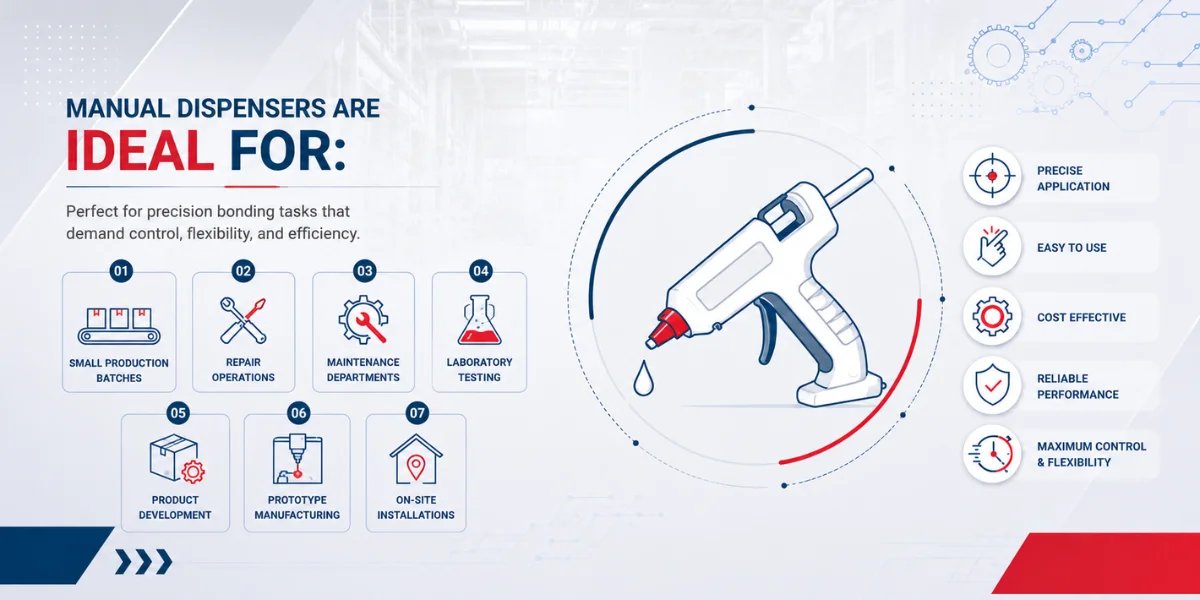
Manual dispensers are ideal for:
1. Small production batches
2. Repair operations
3. Maintenance departments
4. Laboratory testing
5. Product development
6. Prototype manufacturing
7. On-site installations
For continuous high-volume production, automated dispensing systems may be more suitable.
A manual glue dispenser is the best choice for low-volume production, repair work, maintenance tasks, prototype development, laboratory testing, and applications where flexibility and portability are more important than automation.
Yes. Manual glue dispensers are widely used in industrial manufacturing for assembly, maintenance, quality control, and small-batch production. They provide precise adhesive application without the need for compressed air or electrical power.
Absolutely. A manual glue dispenser is ideal for prototype manufacturing and research and development because it allows operators to apply adhesives with greater control and precision. This makes it easier to test different bonding methods and make adjustments before moving to full-scale production.
Common Problems Caused by Choosing the Wrong Manual Glue Dispenser
Using an unsuitable dispenser often results in operational challenges such as:
1. Uneven glue beads
2. Adhesive leakage
3. Material wastage
4. Trigger sticking
5. Poor bonding performance
6. Slow application speed
7. Air pockets in adhesive
8. Excessive operator fatigue
9. Frequent cartridge failures
Choosing a dispenser matched to your adhesive and application helps avoid these issues.
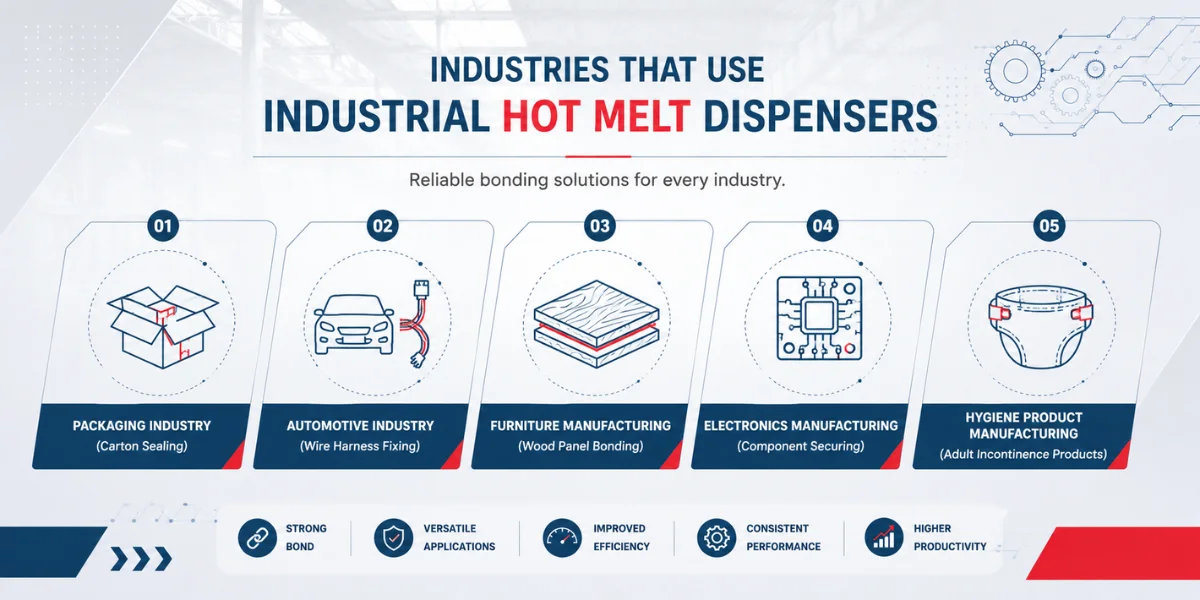
Which Industries Use Manual Glue Dispensers?
Manual dispensing equipment is widely used across multiple industries.
1. Packaging Industry –
For carton sealing, specialty packaging, and low-volume adhesive application.
For carton sealing, specialty packaging, and low-volume adhesive application.
2. Automotive Industry –
For repairs, interior assembly, sealing, and component bonding.
For repairs, interior assembly, sealing, and component bonding.
3. Electronics Manufacturing –
For accurate adhesive application on delicate components.
For accurate adhesive application on delicate components.
4. Furniture Manufacturing –
For wood assembly, edge bonding, and decorative applications.
For wood assembly, edge bonding, and decorative applications.
5. Construction Industry –
For applying sealants, structural adhesives, and joint fillers.
For applying sealants, structural adhesives, and joint fillers.
6. Aerospace –
For maintenance, repair, and specialized bonding applications.
For maintenance, repair, and specialized bonding applications.
7. General Manufacturing –
For assembly operations requiring controlled adhesive application.
For assembly operations requiring controlled adhesive application.
Signs It's Time to Replace Your Manual Glue Dispenser
Consider replacing your dispenser if you notice:
1. Inconsistent dispensing
2. Adhesive dripping
3. Trigger stiffness
4. Broken frame
5. Cartridge slippage
6. Frequent clogging
7. Uneven pressure
8. Difficulty applying high-viscosity adhesives
Replacing worn equipment often improves both productivity and adhesive efficiency.
Why Manufacturers Choose the EcoPlus Manual Glue Dispenser
When selecting an industrial dispensing solution, reliability and ease of use are just as important as precision.
The EcoPlus Manual Glue Dispenser from Mahisa is designed to provide:
1. Smooth and controlled adhesive dispensing
2. Ergonomic handling for reduced operator fatigue
3. Durable construction for industrial environments
4. Consistent adhesive application
5. Compatibility with a range of industrial adhesive cartridges
6. Reduced adhesive waste through better flow control
7. Easy operation and maintenance
It is well-suited for manufacturing facilities, maintenance departments, assembly lines, repair workshops, and production environments where dependable manual dispensing is required.
The EcoPlus Manual Glue Dispenser is designed for industrial use, offering smooth and controlled adhesive dispensing, an ergonomic design for operator comfort, durable construction, and consistent performance across applications such as assembly, maintenance, repairs, and small-batch manufacturing.
The EcoPlus Manual Glue Dispenser is suitable for a wide range of industries, including packaging, automotive, furniture manufacturing, electronics, construction, signage, and general industrial assembly. It is ideal wherever precise manual adhesive application is required.
The EcoPlus Manual Glue Dispenser offers better adhesive flow control, reduced operator fatigue, improved dispensing accuracy, and robust construction for demanding industrial environments. These features help minimize adhesive waste, improve bonding consistency, and increase productivity compared to standard manual dispensers.
Best Practices for Using a Manual Glue Dispenser
To achieve the best performance:
1. Select the correct adhesive for the application.
2. Use compatible cartridges and nozzles.
3. Clean the nozzle after each use.
4. Store adhesives according to the manufacturer’s recommendations.
5. Apply consistent trigger pressure for an even adhesive bead.
6. Inspect the dispenser regularly for wear or damage.
7. Replace worn components before they affect dispensing quality.
Following these practices helps extend tool life and ensures consistent bonding results.
Conclusion
Choosing the right manual glue dispenser is about more than simply applying adhesive, it directly impacts product quality, material usage, operator comfort, and production efficiency. By considering factors such as adhesive compatibility, cartridge size, dispensing accuracy, ergonomics, durability, and maintenance, manufacturers can select equipment that delivers reliable performance and long-term value.
For businesses looking for a dependable industrial solution, the EcoPlus Manual Glue Dispenser offers the precision, durability, and ease of use needed for a wide range of adhesive dispensing applications.
FAQ's
Choose a manual glue dispenser based on the adhesive type, cartridge size, viscosity, required dispensing accuracy, ergonomic design, and production volume. A dispenser matched to your application improves bonding quality and reduces adhesive waste.
Manual glue dispensers are widely used in packaging, automotive, furniture manufacturing, electronics assembly, construction, maintenance, aerospace, and general industrial manufacturing.
Yes, but the dispenser must be designed for high-viscosity materials. Using the correct dispenser ensures smoother dispensing, better control, and less operator effort.
Key features include durable construction, ergonomic grip, smooth trigger action, consistent adhesive flow, cartridge compatibility, easy maintenance, and reliable dispensing accuracy.
A quality manual glue dispenser provides better control over adhesive flow, helping operators apply only the required amount. This minimizes over-application, reduces cleanup, and lowers overall material costs.
A manual glue dispenser is ideal for low-volume production, repairs, maintenance work, prototyping, laboratory testing, and applications where portability and flexibility are more important than high-speed automation.