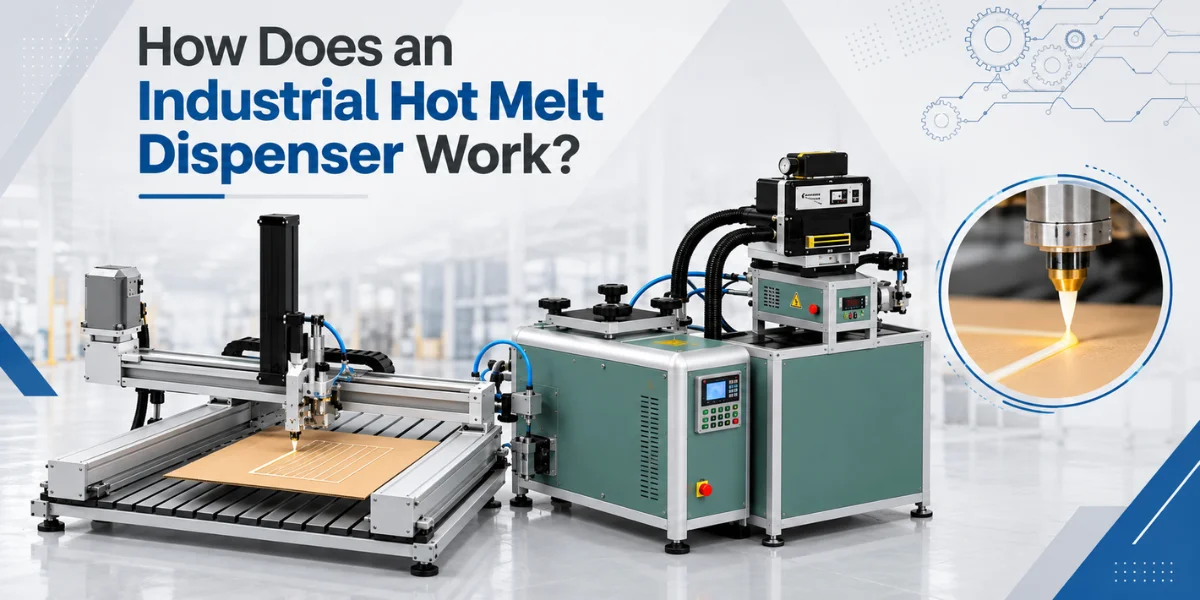
An industrial hot melt dispenser is a machine that melts hot melt adhesive, maintains it at a controlled temperature, and dispenses a precise amount of adhesive onto a surface or product. These systems are widely used in packaging, carton manufacturing, labeling, woodworking, automotive components, electronics, textiles, and other industrial applications where fast and consistent bonding is required.
Unlike manual glue application, an industrial hot melt dispenser can automate adhesive application, control dispensing volume, improve production speed, and reduce adhesive wastage.
But how does an industrial hot melt dispenser actually work?
The basic process is straightforward: solid hot melt adhesive is loaded into the system, heated until it melts, pumped through a controlled delivery system, and dispensed through a nozzle or applicator onto the required surface. The adhesive then cools and solidifies quickly, creating a strong bond.
What Is an Industrial Hot Melt Dispenser?
An industrial hot melt dispenser is an adhesive dispensing system designed to apply thermoplastic hot melt adhesives accurately and consistently in industrial production environments.
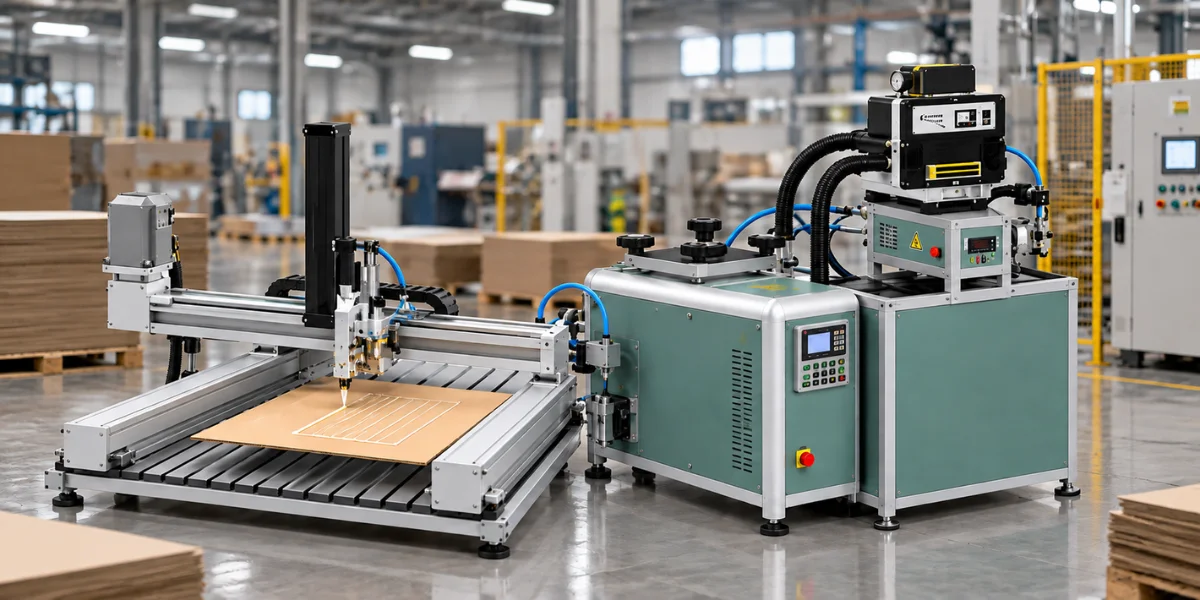
The system generally consists of several key components:
- Adhesive melting tank or reservoir
- Heating elements
- Temperature control system
- Adhesive pump
- Heated hoses
- Dispensing gun or applicator
- Dispensing nozzle
- Pressure control system
- Control panel or PLC
- Sensors and safety mechanisms
Depending on the application, a hot melt dispenser can be configured for bead, spray, slot, dot, spiral, or intermittent adhesive application.
Industrial systems can range from compact manual dispensing units to fully automated hot melt systems integrated with packaging machines and production lines.
How Does an Industrial Hot Melt Dispenser Work?
An industrial hot melt dispenser works through a series of controlled stages.
1. Hot Melt Adhesive Is Loaded
The process starts when solid hot melt adhesive is placed into the machine’s adhesive reservoir or melting tank.
Hot melt adhesives may be supplied in different forms, including:
- Granules
- Pellets
- Blocks
- Sticks
- Slugs
- Powder or other application-specific forms
The adhesive type depends on the material being bonded and the required bonding characteristics.
2. The Adhesive Is Heated
After loading, heating elements inside the machine raise the adhesive temperature until it reaches its required melting range.
The machine’s temperature control system continuously monitors the adhesive temperature.
Maintaining the correct temperature is important because excessive heat can degrade some adhesives, while insufficient heat can prevent proper melting and dispensing.
A typical system may have separate temperature controls for:
- Melting tank
- Pump
- Hose
- Applicator
- Nozzle
This allows the adhesive to remain molten as it travels through the system.
3. The Adhesive Becomes Molten
Once the adhesive reaches the required operating temperature, it changes from a solid into a liquid or molten state.
The molten adhesive is then ready to move through the dispensing system.
At this stage, consistent temperature is critical. If the adhesive cools too much inside the delivery system, its viscosity can increase and affect dispensing consistency.
4. The Pump Moves the Adhesive
A pump transfers the molten adhesive from the tank toward the dispensing applicator.
Depending on the machine design and application, the system may use different pump technologies.
The pump provides controlled adhesive flow and helps maintain the pressure required for consistent dispensing.
This is particularly important in high-speed production environments where the adhesive must be delivered repeatedly and accurately.
5. Heated Hoses Transport the Adhesive
The molten adhesive travels from the pump through heated hoses.
These hoses are designed to maintain the adhesive temperature while transporting it from the melting unit to the dispensing gun or applicator.
The heating system prevents the adhesive from cooling and solidifying before it reaches the dispensing point.
In industrial hot melt systems, temperature management therefore extends throughout the adhesive path, not just inside the main tank.
6. The Applicator Dispenses the Adhesive
The molten adhesive reaches the dispensing gun or applicator.
When the dispensing system receives the appropriate control signal, the applicator opens and releases the adhesive through a nozzle.
Depending on the configuration, the system can produce different adhesive patterns.
Common application patterns include:
Bead application:
A continuous line of adhesive is applied to a surface. This is commonly used for carton sealing, case making, and assembly applications.
Dot application:
Small amounts of adhesive are dispensed at specific points. This is useful when only limited bonding areas are required.
Spray application:
The adhesive is distributed over a wider surface area. Spray systems can be useful for applications requiring broad or patterned coverage.
Slot application:
Adhesive is applied through a slot-shaped opening to create a controlled coating or pattern.
Spiral application:
The adhesive is applied in a spiral pattern, which can help achieve broader coverage while controlling adhesive consumption.
7. The Adhesive Bonds the Materials
After dispensing, the hot melt adhesive is applied to the required surface.
The material is then brought into contact with another surface.
Because hot melt adhesive cools relatively quickly, it transitions back toward a solid state and creates a bond.
This rapid setting characteristic is one of the main reasons hot melt adhesive systems are widely used in automated manufacturing.
FAQs – How Does an Industrial Hot Melt Dispenser Work?
How does an industrial hot melt dispenser work?
An industrial hot melt dispenser works by heating solid hot melt adhesive until it melts, maintaining the required temperature, pumping the molten adhesive through heated hoses, and dispensing it through an applicator and nozzle in a controlled pattern.
What are the main stages in an industrial hot melt dispenser?
The main stages are adhesive loading, heating, melting, pumping, heated transfer, controlled dispensing, and bonding. The system manages temperature, pressure, and dispensing timing to achieve consistent adhesive application.
How does an industrial hot melt dispenser control adhesive flow?
An industrial hot melt dispenser controls adhesive flow through the pump, pressure settings, applicator, nozzle size, and dispensing time. Automated systems can also use PLCs and sensors to synchronize adhesive application with the production line.
How can Mahisa Packaging’s industrial hot melt dispenser support packaging production?
Mahisa Packaging’s industrial hot melt dispenser can be used to achieve controlled and consistent adhesive application in packaging operations. Depending on the system configuration, it can support applications requiring precise glue dispensing for cartons, boxes, and other packaging processes.
Why choose Mahisa Packaging for an industrial hot melt dispenser?
Mahisa Packaging provides industrial adhesive dispensing solutions designed around production requirements such as application speed, adhesive flow, temperature control, and automation. The appropriate industrial hot melt dispenser can help manufacturers achieve repeatable adhesive application while improving production efficiency.
Industrial Hot Melt Dispenser Working Principle
The working principle of an industrial hot melt dispenser can be summarized as:
Load → Melt → Pump → Transport → Dispense → Bond
The system converts solid adhesive into a controlled molten adhesive flow and delivers it to a specific location at a controlled temperature, pressure, and dispensing rate.
In automated applications, the dispensing cycle can also be synchronized with sensors, conveyors, robotic systems, or packaging machinery.
Main Components of an Industrial Hot Melt Dispenser
Understanding the major components makes it easier to understand how the complete system operates.
Adhesive Tank
The adhesive tank stores and melts the hot melt adhesive.
Its capacity depends on the machine and production requirements.
Larger tanks can support applications requiring continuous adhesive supply, while smaller systems may be suitable for lower-volume operations.
Heating Elements
Heating elements provide the thermal energy required to melt the adhesive.
They may be positioned around the tank, hoses, applicators, or other adhesive-contact areas.
Temperature Controller
The temperature controller monitors and regulates the temperature of different components.
Accurate temperature control helps maintain consistent adhesive viscosity and dispensing performance.
Pump
The pump moves molten adhesive from the tank to the applicator.
Pump selection can depend on adhesive characteristics, required flow rate, dispensing pressure, and production speed.
Heated Hose
The heated hose transports molten adhesive between the main unit and the applicator while maintaining the required temperature.
Applicator or Glue Gun
The applicator controls when and where the adhesive is released.
It can be manually operated or integrated with an automated control system.
Nozzle
The nozzle determines how the adhesive exits the applicator.
Different nozzle configurations can create different adhesive patterns, widths, and application volumes.
Control Panel
The control panel allows operators to manage settings such as:
- Temperature
- Pressure
- Adhesive flow
- Application timing
- Operating modes
- Heating zones
Advanced systems may use PLC-based controls and touchscreen interfaces.
Sensors
Sensors can monitor temperature, pressure, adhesive level, machine status, and application timing.
In automated production lines, sensors can also help synchronize adhesive dispensing system with the movement of products.
How Does an Industrial Hot Melt Dispenser Control Adhesive Flow?
Adhesive flow is controlled through a combination of pump operation, pressure, applicator opening time, nozzle design, and machine settings.
For example, if a production line requires a specific adhesive bead, the system can regulate how much adhesive is delivered and when dispensing starts or stops.
In automated applications, the dispenser may receive signals from a PLC, sensor, encoder, or production machine.
This enables adhesive application to remain synchronized with product movement.
How Is Temperature Controlled in a Hot Melt Dispenser?
Temperature is one of the most important parameters in a hot melt dispensing system.
Industrial systems typically use temperature sensors and controllers to monitor individual heating zones.
For example:
Melting tank → Heated hose → Applicator → Nozzle
Each zone can be maintained within its required temperature range.
This helps prevent problems such as:
- Adhesive solidification
- Inconsistent viscosity
- Poor flow
- Nozzle blockage
- Adhesive degradation
- Uneven application
The correct temperature depends on the specific hot melt adhesive being used, so operators should follow the adhesive manufacturer’s recommended processing range rather than relying on a universal temperature.
What Types of Hot Melt Adhesive Can Be Used?
Industrial hot melt dispensers can work with different adhesive technologies.
Common categories include:
- EVA hot melt adhesives
- Polyolefin hot melt adhesives
- Polyamide hot melt adhesives
- Pressure-sensitive hot melts
- PUR hot melt adhesives
Each adhesive has different characteristics, including melting behavior, viscosity, open time, setting time, temperature requirements, and bonding performance.
Therefore, the dispenser should be selected based on the adhesive formulation and the application requirements.
Where Are Industrial Hot Melt Dispensers Used?
Industrial hot melt dispensers are used across many manufacturing industries.
Packaging Industry
Packaging is one of the most common applications.
Hot melt dispensing can be used for:
- Carton sealing
- Box closing
- Case making
- Label application
- Tray forming
- Product assembly
- Packaging components
The fast setting time of hot melt adhesive makes it suitable for high-speed packaging operations.
Food Packaging
Hot melt systems can be used in packaging processes where compatible adhesives and appropriate equipment are selected for the application.
For food-related packaging, adhesive selection and regulatory suitability should always be evaluated according to the intended use and applicable requirements.
Furniture and Woodworking
Hot melt adhesive dispensing can be used for:
- Edge bonding
- Profile wrapping
- Lamination
- Furniture assembly
- Decorative components
Hot melt adhesives may be used for selected automotive components, trim, insulation, interior parts, and other assembly applications where the adhesive formulation is appropriate.
Electronics
Precision hot melt dispensing can be used in certain electronic assembly and component-protection applications.
The exact adhesive and dispensing method depend on the sensitivity of the components and required bond characteristics.
Textile and Nonwoven Applications
Hot melt systems can be used for bonding fabrics, nonwoven materials, labels, and other textile components.
FAQs – Where Are Industrial Hot Melt Dispensers Used?
Which industries use industrial hot melt dispensers?
Industrial hot melt dispensers are widely used in packaging, carton manufacturing, furniture, woodworking, automotive, textiles, nonwoven materials, electronics, labeling, and general product assembly.
How are industrial hot melt dispensers used in packaging?
In packaging, an industrial hot melt dispenser can apply precise adhesive beads, dots, or other patterns for carton sealing, box closing, case making, tray forming, labeling, and packaging assembly.
Can industrial hot melt dispensers be used for high-speed production lines?
Yes. Industrial hot melt dispensers can be integrated with automated production lines, conveyors, sensors, and PLC systems to deliver adhesive at controlled speeds and synchronized intervals.
Are industrial hot melt dispensers suitable for different adhesive applications?
Yes. Depending on the machine configuration and adhesive formulation, industrial hot melt dispensers can support different application methods, including bead, dot, spray, slot, and spiral dispensing.
What Are the Advantages of an Industrial Hot Melt Dispenser?
An industrial hot melt dispenser can offer several operational advantages.
Faster Adhesive Application
Automated dispensing can apply adhesive significantly faster and more consistently than manual application in suitable production environments.
Consistent Adhesive Patterns
The machine can maintain repeatable adhesive beads, dots, or other patterns.
Reduced Adhesive Waste
Precise dispensing can help control the quantity of adhesive used per product.
Faster Bonding
Hot melt adhesives generally set quickly as they cool, allowing products to move through production processes without long curing periods.
Better Production Control
Automated systems can synchronize adhesive application with conveyors, packaging machines, robots, and sensors.
Improved Workplace Efficiency
Reducing repetitive manual adhesive application can help operators focus on other production activities.
Industrial Hot Melt Dispenser vs Manual Glue Application
The primary difference between an industrial hot melt dispenser and manual glue application is the level of control, consistency, and automation.
| Feature | Industrial Hot Melt Dispenser | Manual Application |
|---|---|---|
| Application speed | High | Lower |
| Adhesive control | Precise | Operator dependent |
| Application consistency | High | Can vary |
| Automation | Possible | Limited |
| Production volume | Medium to high | Low to medium |
| Adhesive wastage | Can be controlled | Can be higher |
| Integration | PLC/production-line integration possible | Usually standalone |
For high-volume manufacturing, an automated or semi-automated system can provide greater process consistency.
How Does an Automatic Hot Melt Dispenser Work With a Production Line?
An automatic hot melt dispenser can be integrated with a production line using sensors, PLCs, conveyors, and machine-control signals.
For example, in carton production:
Carton enters application area → Sensor detects carton → PLC sends signal → Applicator opens → Hot melt bead is applied → Carton moves to compression section → Adhesive cools and bonds
This sequence can repeat continuously during production.
The dispensing timing can be adjusted according to product dimensions, conveyor speed, adhesive requirements, and application pattern.
What Factors Affect Hot Melt Dispensing Performance?
Several factors can affect the performance of an industrial hot melt dispenser.
Adhesive Temperature
Incorrect temperature can change adhesive viscosity and affect flow.
Adhesive Viscosity
Different adhesives require different pumping and dispensing conditions.
Pump Pressure
Insufficient or excessive pressure can affect adhesive flow and pattern consistency.
Nozzle Selection
The nozzle influences bead size, pattern, and application precision.
Dispensing Speed
The production line’s speed must be matched with the adhesive flow and dispensing cycle.
Adhesive Quality
Variations in adhesive formulation can affect melting, flow, bonding, and machine performance.
Equipment Maintenance
Blocked nozzles, worn components, or poorly maintained heating systems can reduce dispensing accuracy.
Common Problems With Industrial Hot Melt Dispensers
Even well-designed systems require correct operation and maintenance.
Nozzle Blockage
Adhesive buildup can restrict flow through the nozzle.
Possible solution: Follow the equipment manufacturer’s cleaning procedure and maintain the recommended operating conditions.
Uneven Adhesive Bead
An inconsistent bead can result from incorrect temperature, pressure, nozzle selection, or adhesive flow.
Adhesive Not Melting Properly
This may occur because of incorrect temperature settings, heating-element issues, or unsuitable adhesive.
Adhesive Dripping
Dripping may be associated with applicator settings, nozzle condition, pressure, or adhesive characteristics.
Slow Adhesive Flow
Low temperature, incorrect viscosity, restricted hoses, or pump-related problems may reduce flow.
How Do You Choose an Industrial Hot Melt Dispenser?
Choosing the right industrial hot melt dispenser requires evaluating the complete production application rather than selecting equipment based only on machine capacity.
Consider these factors:
1. Type of Adhesive
Determine whether you will use EVA, polyolefin, polyamide, PUR, or another hot melt formulation.
2. Required Adhesive Output
Calculate the amount of adhesive required per product and per hour.
3. Application Pattern
Determine whether you require:
- Bead
- Dot
- Spray
- Spiral
- Slot
- Intermittent application
4. Production Speed
The machine should support the required production rate without compromising dispensing consistency.
5. Number of Application Points
Some applications require one nozzle, while others need multiple applicators operating simultaneously.
6. Automation Requirements
Consider whether the dispenser needs to connect with:
- PLC systems
- Conveyors
- Sensors
- Robots
- Packaging machines
- Encoders
7. Temperature Requirements
Ensure the system can safely and accurately operate within the adhesive manufacturer’s recommended temperature range.
8. Maintenance Requirements
Look for a system that allows practical access to components requiring regular maintenance, such as filters, nozzles, hoses, and adhesive-contact parts.
FAQs – How Do You Choose an Industrial Hot Melt Dispenser?
What factors should you consider when choosing an industrial hot melt dispenser?
Consider the adhesive type, required adhesive output, melting temperature, production speed, dispensing pattern, number of application points, automation requirements, tank capacity, and compatibility with your production line.
How do I choose the right industrial hot melt dispenser for packaging applications?
For packaging applications, consider the type and size of cartons, required adhesive pattern, production volume, dispensing speed, adhesive consumption, and whether the system needs to integrate with an automated packaging line.
Does the type of hot melt adhesive affect dispenser selection?
Yes. Different adhesives, such as EVA, polyolefin, polyamide, and PUR, have different temperature, viscosity, and processing requirements. The industrial hot melt dispenser should be compatible with the specific adhesive being used.
Can an industrial hot melt dispenser be customized for different production requirements?
Yes. Depending on the application, an industrial hot melt dispenser can be configured with different tank capacities, pumps, heated hoses, applicators, nozzles, controls, and automation features to suit specific production requirements.
How Does Maintenance Affect Hot Melt Dispenser Performance?
Regular maintenance helps maintain reliable adhesive dispensing.
A maintenance program may include:
- Checking adhesive levels
- Inspecting hoses
- Cleaning nozzles
- Checking filters
- Inspecting applicators
- Checking temperature sensors
- Inspecting heating elements
- Checking pump operation
- Removing adhesive buildup
- Following manufacturer-recommended maintenance intervals
Maintenance requirements vary according to machine design, adhesive type, operating hours, and production environment.
Industrial Hot Melt Dispenser: A Simple Example
Consider a carton manufacturing line.
A carton moves along a conveyor toward the adhesive application station.
A sensor detects the carton.
The control system sends a signal to the hot melt dispenser.
The pump delivers molten adhesive to the applicator.
The applicator opens for a predetermined period.
The nozzle applies a controlled bead of adhesive to the carton flap.
The carton folds into position and compression holds the surfaces together.
As the adhesive cools, it forms the required bond.
The finished carton then continues to the next stage of production.
This example shows how an industrial hot melt dispenser can combine heating, pumping, precise dispensing, and automation into one adhesive application process.
Conclusion
An industrial hot melt dispenser combines controlled heating, pumping, temperature management, and precision dispensing to deliver molten adhesive where it is required.
Its basic working process is simple:
Solid adhesive → Heating → Melting → Pumping → Heated transfer → Dispensing → Cooling → Bonding
However, achieving reliable industrial performance requires the right combination of adhesive, temperature, pump, hose, applicator, nozzle, pressure, and control system.
For manufacturers, the right industrial hot melt dispenser can help create consistent adhesive patterns, improve production efficiency, reduce unnecessary adhesive consumption, and support automation across packaging and manufacturing operations.
When selecting a system, the machine should be evaluated according to the specific adhesive, production speed, application pattern, bonding material, and level of automation required.
Frequently Asked Questions About Industrial Hot Melt Dispensers
What is an industrial hot melt dispenser?
An industrial hot melt dispenser is a machine that melts hot melt adhesive and delivers it through a controlled dispensing system. It can apply adhesive as beads, dots, sprays, spirals, or other patterns depending on the applicator and nozzle configuration.
How does an industrial hot melt dispenser work?
An industrial hot melt dispenser works by heating solid adhesive in a melting tank, pumping the molten adhesive through heated hoses, and dispensing it through an applicator and nozzle. The adhesive is then applied to the required surface and cools to form a bond.
What is the purpose of a heated hose in a hot melt system?
A heated hose keeps molten adhesive at the required temperature while it travels from the adhesive tank or pump to the applicator. This helps prevent premature cooling and solidification inside the adhesive delivery line.
How does a hot melt dispenser control adhesive quantity?
Adhesive quantity can be controlled through factors such as pump output, pressure, nozzle configuration, applicator opening time, and dispensing speed. Automated systems can also use PLC controls, sensors, or other signals to regulate application timing.
Can an industrial hot melt dispenser be automated?
Yes. Industrial hot melt dispensers can be integrated with PLCs, sensors, conveyors, robots, packaging machines, and other production equipment. Automation allows adhesive application to be synchronized with product movement and production cycles.
What industries use industrial hot melt dispensers?
Industrial hot melt dispensers are used in packaging, carton manufacturing, woodworking, furniture, automotive components, textiles, nonwoven products, electronics, labeling, and various assembly applications.
What causes hot melt adhesive to clog a nozzle?
Nozzle clogging can result from adhesive buildup, unsuitable operating conditions, contamination, prolonged exposure to heat, or inadequate cleaning and maintenance. The appropriate solution depends on the adhesive and equipment manufacturer’s recommendations.
What temperature should an industrial hot melt dispenser operate at?
There is no single temperature suitable for every hot melt adhesive. The correct operating temperature depends on the adhesive formulation and should be based on the adhesive manufacturer’s specified processing range and the equipment manufacturer’s requirements.
How can an industrial hot melt dispenser reduce adhesive waste?
A controlled dispensing system can apply a consistent amount of adhesive to each product, reducing excessive application caused by manual methods. Proper nozzle selection, pressure control, timing, and machine calibration can further improve adhesive usage.
What should you consider when buying an industrial hot melt dispenser?
Consider the adhesive type, required melting temperature, adhesive output, production speed, dispensing pattern, number of application points, automation requirements, tank capacity, maintenance requirements, and compatibility with your existing production line.