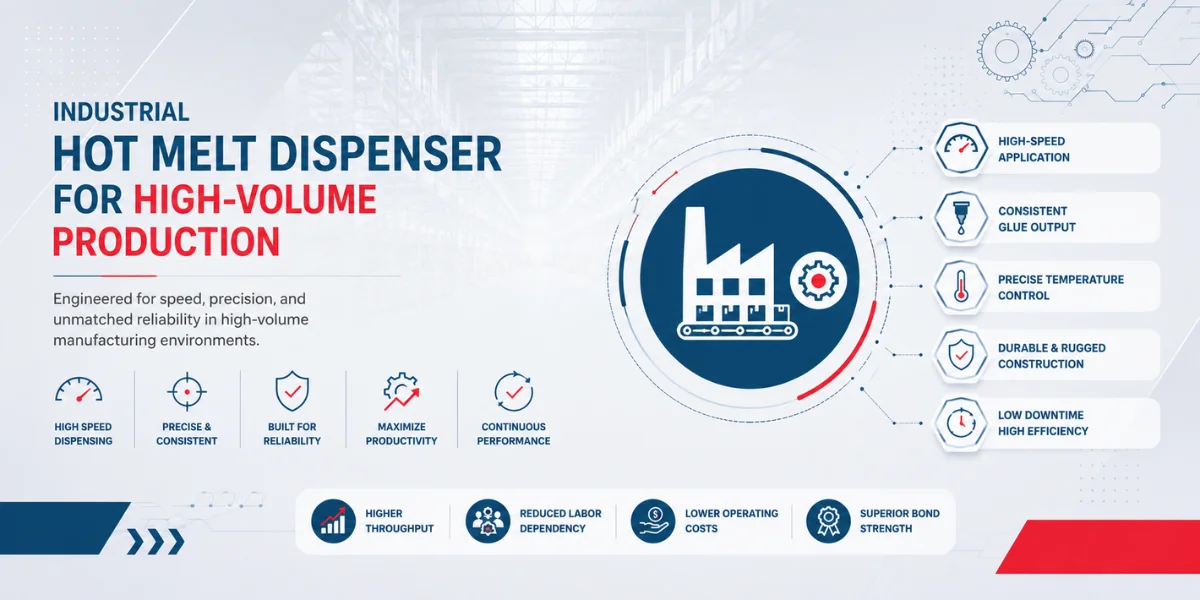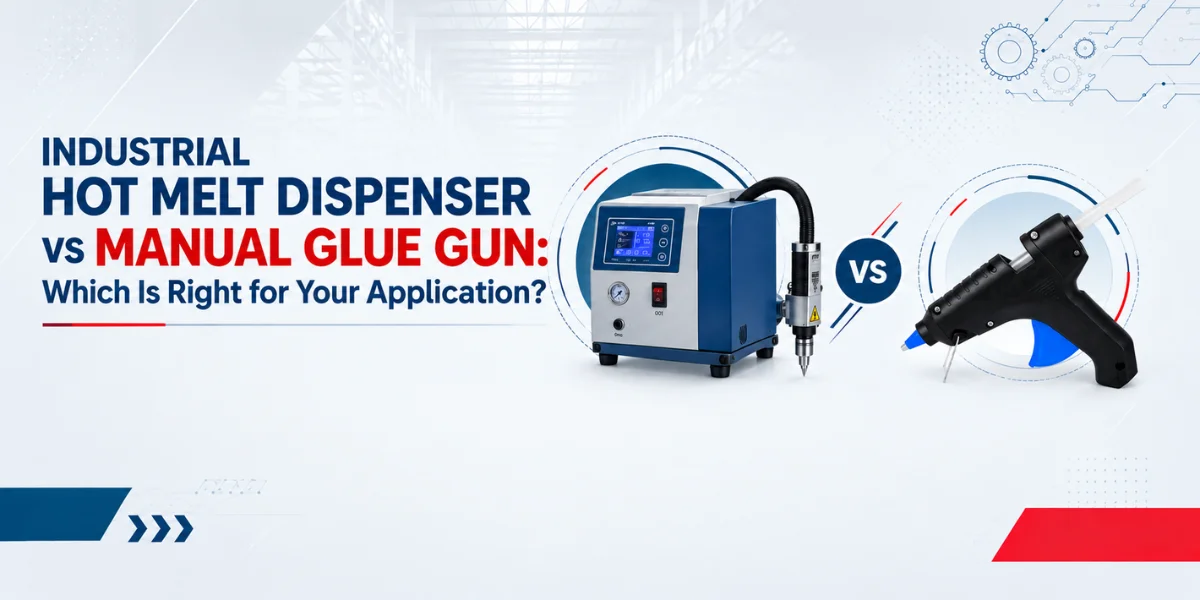
When comparing an industrial hot melt dispenser vs manual glue gun, the key difference is how the adhesive is heated, controlled, dispensed, and integrated into a production process. A manual glue gun is generally suitable for small-volume, occasional, or hand-operated bonding, while an industrial hot melt dispenser is designed for continuous production, precise adhesive application, and integration with manufacturing equipment.
For businesses handling packaging, assembly, labeling, product manufacturing, or high-volume bonding, an industrial hot melt dispenser can provide greater consistency, speed, control, and production efficiency than a conventional manual glue gun.
What Is an Industrial Hot Melt Dispenser?
An industrial hot melt dispenser is a professional adhesive application system used to melt and dispense hot melt adhesive in controlled quantities. Depending on the application, the system can include a heated adhesive tank, temperature controls, hoses, dispensing guns, nozzles, pumps, and automated controls.
Industrial hot melt dispensers are commonly used for:
- Carton sealing
- Case and box closing
- Packaging applications
- Product assembly
- Bookbinding
- Labeling
- Furniture manufacturing
- Electronics assembly
- Automotive components
- Nonwoven and hygiene products
- Industrial product bonding
The main purpose of an industrial system is to provide consistent adhesive flow and controlled application during repetitive production processes.
What Is a Manual Glue Gun?
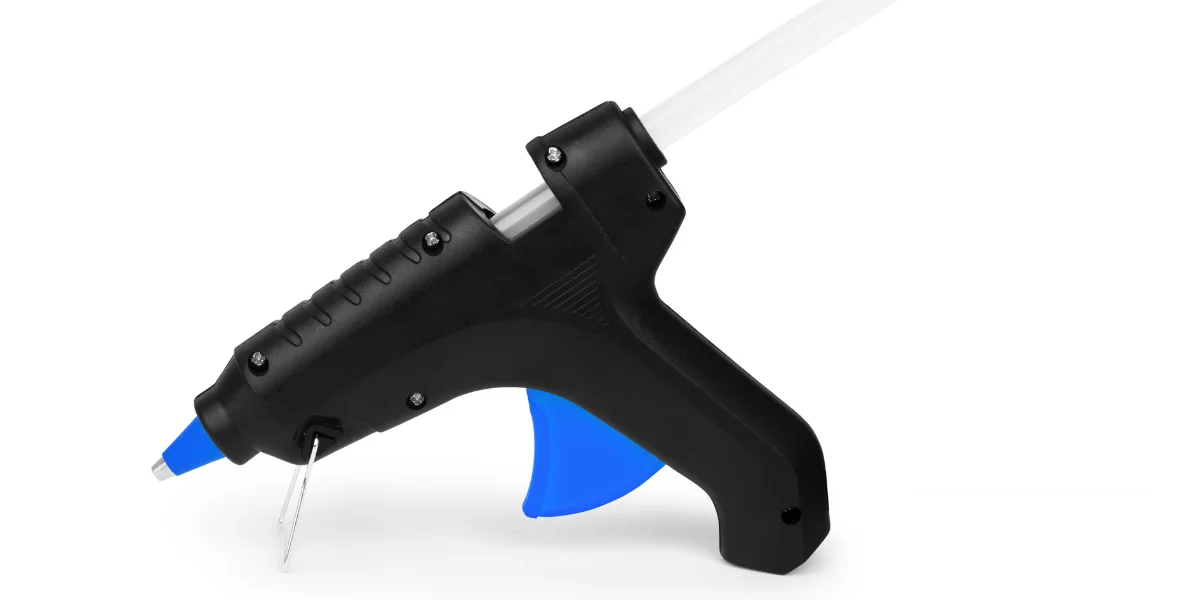
A manual glue gun is a handheld adhesive application tool that uses hot melt glue sticks. The glue stick is inserted into the gun, heated internally and pushed through a nozzle by manually operating a trigger.
Manual glue guns are generally used for:
- Craft projects
- Repairs
- DIY applications
- Small packaging jobs
- Prototyping
- Low-volume assembly
- Temporary or occasional bonding
They are simple to operate and relatively inexpensive, making them practical where production volume and application precision are not major concerns.
Industrial Hot Melt Dispenser vs Manual Glue Gun: Key Differences
The biggest differences between an industrial hot melt dispenser and a manual glue gun are production capacity, adhesive control, application consistency, automation, and operator involvement.
| Feature | Industrial Hot Melt Dispenser | Manual Glue Gun |
|---|---|---|
| Application | Industrial production | Small-scale/manual work |
| Adhesive supply | Bulk adhesive or industrial supply | Glue sticks |
| Production volume | Medium to high | Low |
| Application control | High | Basic |
| Adhesive quantity | Precisely controlled | Operator controlled |
| Automation | Can integrate with machines | Mostly manual |
| Continuous operation | Designed for production | Limited |
| Speed | High | Relatively low |
| Temperature control | Advanced | Basic |
| Integration | Production lines and machinery | Handheld operation |
| Operator dependency | Lower with automation | High |
| Best suited for | Manufacturing and packaging | DIY, repair and low-volume work |
How Does an Industrial Hot Melt Dispenser Work?
An industrial hot melt dispenser typically heats adhesive to a controlled temperature and delivers it through a dispensing system.
The basic process is:
Adhesive supply → Heating → Temperature control → Pumping/feeding → Dispensing → Bonding
The adhesive is first introduced into a heated reservoir or supply system. The heating unit brings the adhesive to its required melting temperature.
Once the adhesive reaches the appropriate temperature, a pump or feeding mechanism moves it through a heated hose toward the dispensing gun or nozzle.
The adhesive can then be applied as:
- Beads
- Dots
- Lines
- Spirals
- Sprays
- Patterns
- Controlled deposits
This allows manufacturers to select an application method based on the material, product design, production speed, and bonding requirements.
How Does a Manual Glue Gun Work?
A manual glue gun follows a much simpler process.
A glue stick is inserted into the back of the gun. An internal heating element melts the adhesive, and the operator presses the trigger to push the melted glue toward the nozzle.
The basic process is:
Glue stick → Heating → Manual trigger → Nozzle → Application
Because the operator controls the trigger manually, the amount and speed of adhesive applied can vary.
For occasional jobs, this may not be a significant issue. However, when hundreds or thousands of products need to be bonded consistently, variation in adhesive application can affect production quality.
Industrial Hot Melt Dispenser vs Manual Glue Gun: Which Is Faster?
An industrial hot melt dispenser is generally faster for repetitive production applications because it is designed for continuous adhesive dispensing and can be integrated with automated or semi-automated equipment.
A manual glue gun requires the operator to:
- Insert glue sticks.
- Wait for adhesive to heat.
- Position the product.
- Pull the trigger.
- Apply the adhesive.
- Repeat the process.
- Replace glue sticks when required.
An industrial dispenser can use a larger adhesive supply and maintain a continuous dispensing process.
This becomes particularly important in packaging and manufacturing environments where adhesive application is repeated hundreds or thousands of times per shift.
Which Provides Better Adhesive Control?
Industrial hot melt dispensers generally provide greater adhesive control than manual glue guns.
With an industrial system, manufacturers can control factors such as:
- Temperature
- Adhesive flow
- Dispensing pattern
- Application timing
- Adhesive quantity
- Application pressure
- Dispensing speed
In automated applications, adhesive dispensing can also be synchronized with the movement of a production line or machine.
With a manual glue gun, the operator has significantly more influence over the amount and placement of adhesive.
This can result in differences between individual products.
Which Is Better for High-Volume Production?
For high-volume manufacturing, an industrial hot melt dispenser is generally more suitable.
A manual glue gun is designed around individual operator actions, whereas an industrial hot melt system can be designed around the production process.
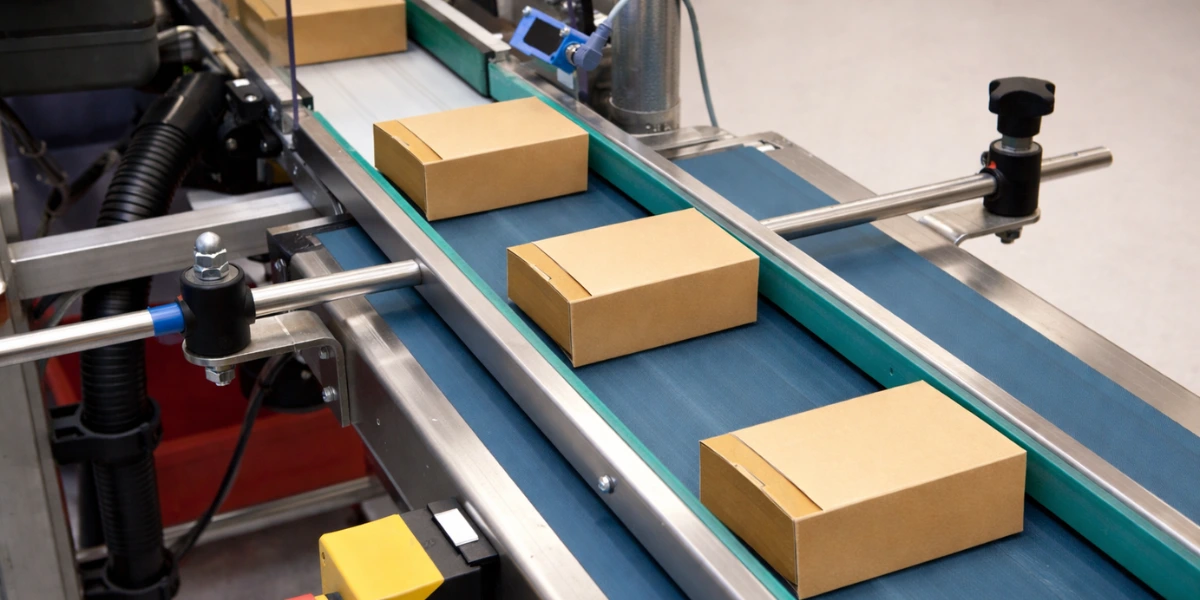
For example, an automated packaging line may require adhesive to be applied at a specific location on every carton.
An industrial dispensing system can be configured to apply adhesive at the required position and timing.
This helps reduce variation and makes the adhesive application process more repeatable.
Industrial Hot Melt Dispenser vs Manual Glue Gun for Packaging
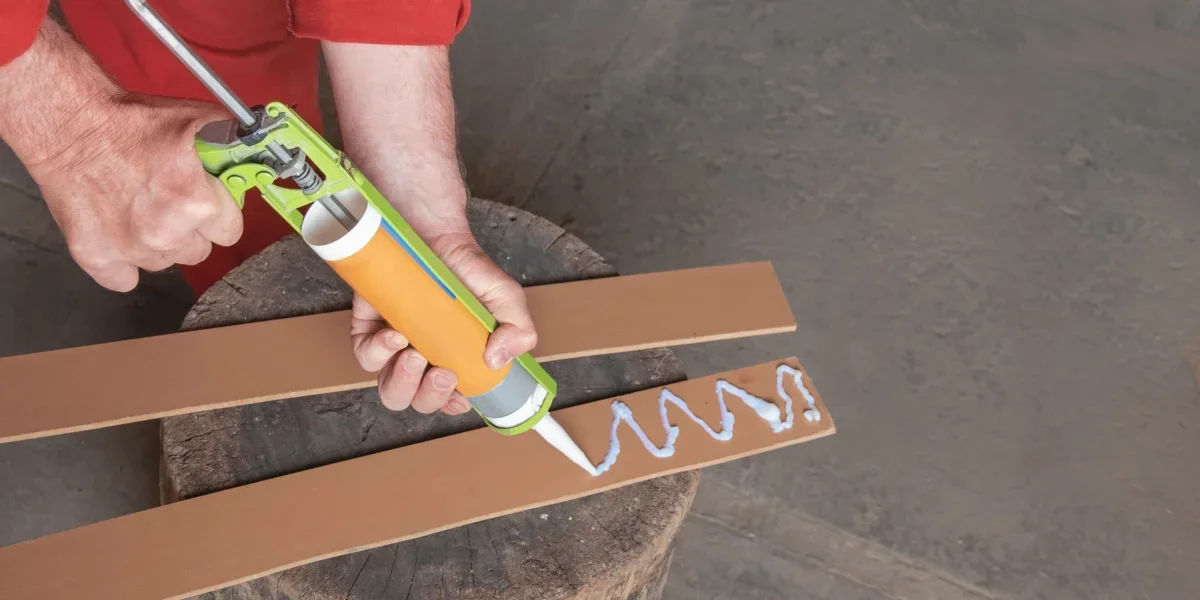
Packaging is one of the clearest areas where the two systems differ.
Manual glue gun
A manual glue gun may be appropriate for:
- Small packaging batches
- Handmade products
- Sample packaging
- Prototypes
- Occasional carton sealing
- Small business operations
Industrial hot melt dispenser
An industrial dispenser is more suitable for:
- High-volume carton sealing
- Case closing
- Box manufacturing
- Packaging lines
- Automatic packaging equipment
- Repetitive adhesive application
For a packaging manufacturer, the ability to control adhesive placement and quantity can be particularly important.
FAQs – Industrial Hot Melt Dispenser vs Manual Glue Gun for Packaging
Is an industrial hot melt dispenser better for high-volume packaging?
An industrial hot melt dispenser is designed for continuous and repetitive packaging applications, offering consistent adhesive application and faster production.
Can a manual glue gun be used for packaging?
Yes, a manual glue gun can be useful for small batches, prototypes, handmade packaging, and occasional carton sealing where production volume is low.
How does an industrial hot melt dispenser improve packaging efficiency?
It can provide controlled adhesive dispensing, reduce repetitive manual work, and integrate with automated packaging machinery for consistent application.
What should packaging manufacturers consider when choosing between the two?
Consider production volume, application speed, adhesive consumption, required consistency, operator involvement, and whether the packaging process needs automation.
Industrial Hot Melt Dispenser vs Manual Glue Gun: Adhesive Consumption
Adhesive consumption can differ significantly between the two systems.
With a manual glue gun, operators may apply more adhesive than necessary because the amount depends on trigger pressure, application technique, and experience.
An industrial system can be configured to deliver a controlled amount of adhesive.
This can help manufacturers:
- Reduce adhesive waste
- Improve bonding consistency
- Control production costs
- Maintain repeatable application
- Reduce excessive adhesive buildup
However, actual adhesive consumption depends on the adhesive type, substrate, application pattern, bonding area, machine settings, and production requirements.
Which One Offers Better Temperature Control?
Temperature control is another important difference.
Manual glue guns generally have relatively simple heating systems. Some models may provide adjustable temperature settings, but control is usually intended for basic applications.
Industrial hot melt systems can provide more sophisticated temperature management across components such as:
- Adhesive tanks
- Hoses
- Applicators
- Nozzles
- Dispensing heads
Maintaining the appropriate adhesive temperature is important because excessive or insufficient heating can affect adhesive viscosity and application performance.
Can an Industrial Hot Melt Dispenser Be Automated?
Yes. Industrial hot melt dispensers can be integrated with automated and semi-automated production equipment.
Depending on the system, dispensing can be triggered by:
- Sensors
- Timers
- Machine signals
- Programmable controls
- Production-line movement
- Robotic systems
- PLC-based automation
This makes industrial hot melt dispensing suitable for manufacturing environments where adhesive application needs to happen at a precise point in the production cycle.
A manual glue gun, by comparison, requires the operator to control the application directly.
Industrial Hot Melt Dispenser vs Manual Glue Gun: Operator Dependency
A manual glue gun is highly dependent on the operator.
The operator controls:
- Where the adhesive is applied
- How much adhesive is applied
- How quickly it is applied
- When adhesive is applied
- When the glue stick is replaced
Industrial dispensing systems can reduce this dependency, especially when integrated into automated equipment.
The operator can focus more on loading materials, monitoring the process, quality checks, and machine operation rather than manually applying every adhesive bead.
FAQs – Industrial Hot Melt Dispenser vs Manual Glue Gun: Operator Dependency
How does operator involvement differ between an industrial hot melt dispenser and a manual glue gun?
An industrial hot melt dispenser can automate adhesive application, reducing repetitive manual work. A manual glue gun requires the operator to control adhesive placement, quantity, and application speed.
Can an industrial hot melt dispenser reduce operator workload?
Yes. An industrial hot melt dispenser can handle consistent adhesive dispensing and integrate with automated machinery, allowing operators to focus on monitoring and other production tasks.
Does a manual glue gun require more operator control?
Yes. With a manual glue gun, the operator directly controls when, where, and how much adhesive is applied, making the process more dependent on individual handling.
Which is more suitable for repetitive adhesive application?
An industrial hot melt dispenser is generally more suitable for repetitive production applications because it can provide consistent dispensing while reducing continuous manual intervention.
Which Is Easier to Use?
For a simple, occasional task, a manual glue gun is generally easier to start using.
It typically requires:
- Insert a glue stick.
- Connect or switch on the gun.
- Allow it to heat.
- Pull the trigger.
- Apply adhesive.
An industrial hot melt dispenser involves more components and setup. Depending on the system, users may need to manage:
- Adhesive loading
- Temperature settings
- Hoses
- Applicators
- Nozzles
- Pressure or flow settings
- Cleaning and maintenance
Therefore, ease of use depends on the application. Simplicity favors a manual glue gun, while production control favors an industrial dispensing system.
Which Has a Lower Initial Cost?
A manual glue gun typically has a lower initial purchase cost than an industrial hot melt dispensing system.
However, initial equipment cost should not be the only consideration for a production environment.
Businesses should also consider:
- Labour requirements
- Adhesive consumption
- Production speed
- Downtime
- Product consistency
- Maintenance
- Scrap and rework
- Production volume
- Automation requirements
For occasional applications, investing in an industrial system may not be necessary.
For continuous manufacturing, however, production efficiency can become more important than the initial equipment price.
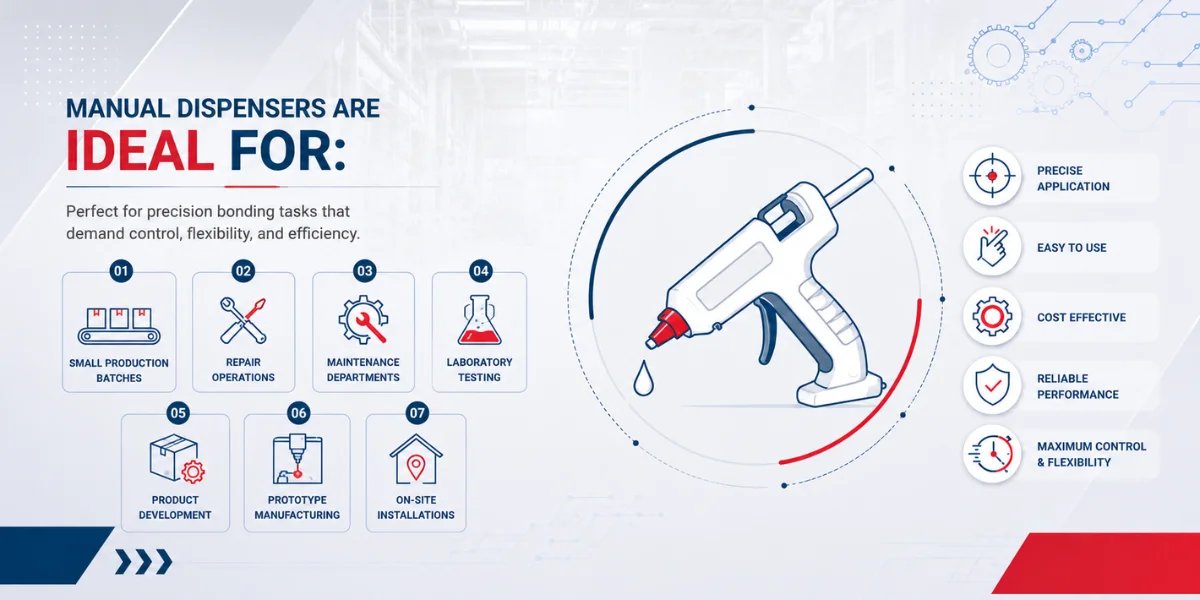
When Should You Choose a Manual Glue Gun?
A manual glue gun may be suitable when:
- Production volume is low.
- Adhesive application is occasional.
- Products are handmade.
- Applications change frequently.
- Automation is unnecessary.
- The bonding area is small.
- Budget is a major consideration.
- The operator needs maximum flexibility.
For DIY, craft, repair, prototyping, and small-batch applications, a manual glue gun can provide a practical solution.
When Should You Choose an Industrial Hot Melt Dispenser?
An industrial hot melt dispenser becomes more appropriate when:
- Production volume is high.
- Adhesive is applied repeatedly.
- Consistency is important.
- Production speed matters.
- Adhesive waste needs to be controlled.
- Multiple dispensing points are required.
- The process needs automation.
- The dispenser needs to integrate with machinery.
- Precise adhesive application is required.
If adhesive application is a critical part of a manufacturing process, an industrial system can provide significantly greater control than a handheld glue gun.
Industrial Hot Melt Dispenser vs Manual Glue Gun: Decision Guide
Use this simple decision framework:
Choose a manual glue gun if:
Low volume + manual work + simple application = Manual glue gun
Choose an industrial hot melt dispenser if:
High volume + repetitive application + consistency + automation = Industrial hot melt dispenser
The right choice ultimately depends on the production environment, adhesive requirements, application pattern, throughput, and level of automation required.
Industrial Hot Melt Dispenser vs Manual Glue Gun: Final Comparison
The choice between an industrial hot melt dispenser vs manual glue gun depends primarily on the scale and requirements of the application.
A manual glue gun offers simplicity, flexibility, and low-cost operation for small jobs. An industrial hot melt dispenser is designed for controlled, repeatable, and potentially automated adhesive application in manufacturing environments.
For manufacturers evaluating adhesive equipment, the most important questions are not simply “Which tool is cheaper?” but:
- How many products need to be bonded?
- How frequently is adhesive applied?
- How much adhesive is required per product?
- How consistent must the application be?
- Can the process be automated?
- How much operator time is required?
- What level of production control is needed?
Answering these questions can help determine whether a manual glue gun is sufficient or whether an industrial hot melt dispensing system is better suited to the production process.
About Mahisa Packaging Systems LLP
Mahisa Packaging Systems LLP provides industrial adhesive dispensing and packaging machinery solutions designed for manufacturing and packaging applications. When selecting a hot melt dispensing system, businesses can evaluate factors such as adhesive compatibility, dispensing requirements, production speed, automation, and machine integration to identify a suitable configuration.
Frequently Asked Questions
Is an industrial hot melt dispenser better than a manual glue gun?
An industrial hot melt dispenser provides greater control, consistency, and automation potential, making it more suitable for production environments. A manual glue gun is generally more appropriate for small-scale, occasional, or hand-operated applications.
Can a manual glue gun be used for industrial applications?
A manual glue gun can be used for certain low-volume industrial tasks, repairs, prototyping, or maintenance work. However, it may not be suitable for high-volume production where consistent adhesive quantity, speed, and repeatability are required.
Does an industrial hot melt dispenser reduce glue waste?
An industrial hot melt dispenser can help reduce adhesive waste by providing more controlled dispensing. Actual savings depend on the adhesive, application pattern, equipment settings, and production process.
Can an industrial hot melt dispenser be connected to an automated machine?
Yes. Many industrial hot melt dispensing systems can be integrated with packaging machinery, production lines, sensors, PLCs, and other automated equipment, depending on the system configuration.
What industries use industrial hot melt dispensers?
Industrial hot melt dispensers are used across packaging, carton manufacturing, product assembly, furniture, bookbinding, labeling, automotive components, electronics, hygiene products, and other manufacturing applications.
How do I choose between an industrial hot melt dispenser and a manual glue gun?
Consider production volume, adhesive type, application speed, required precision, operator involvement, adhesive consumption, automation requirements, and total operating cost. Low-volume manual work may suit a glue gun, while repetitive production applications may require an industrial dispensing system.